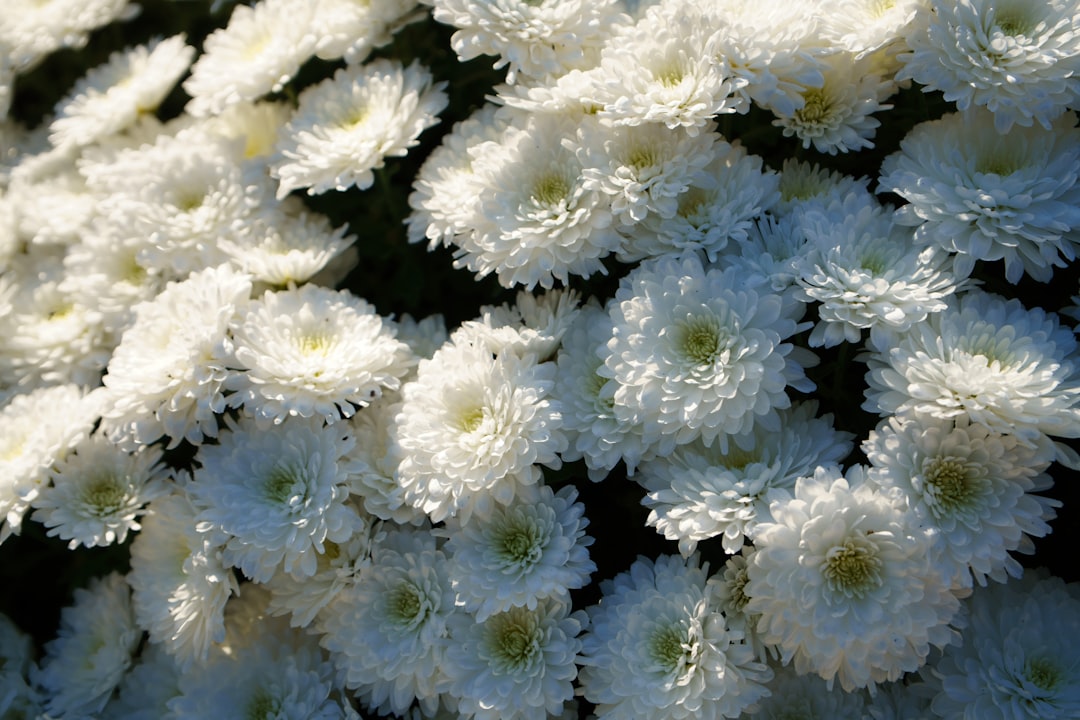
White Chrysanthemums and Arirang
I. White Chrysanthemums
The white chrysanthemums are always laid out before dawn.
The hillside stands at the edge of Yokohama, where Kuboyama lives, and the sea wind climbs up from below, carrying salt, setting the slope of white chrysanthemums trembling—as if they were nodding. You are eighty-seven this year. Squatting down takes you a long time; standing up takes longer. But these one hundred forty-five white chrysanthemums—you insist on arranging every one yourself. When a young volunteer comes to help and reaches out, you wave her off. “This work, it has to be done with my own hands.”
One flower, one person. One hundred forty-five flowers, one hundred forty-five people who never made it home.
Your hands have shaken for a decade now; you need both to hold a cup of tea. But laying flowers is different—flowers don’t mind. On the little folding stool behind you sits a white porcelain bowl, its rim chipped, like a missing tooth. When the flowers are done, you will go to the old well behind the cemetery, draw a bowl of clear water, carry it to the memorial stone, and set it down gently.
Every year, the same. This year marks the thirteenth.
People have tried to dissuade you: you’re in your eighties—what are you after? Your legs fail more each year—what for? Your daughter calls on the first of September, every year. She doesn’t stop you; she just says it over and over: “Mom, take it slow. If you can’t squat, don’t squat.”
You say: “My mother waited for this day her whole life.”
The girl helping with the flowers doesn’t understand. She asks, timidly: “Grandmother—who is it you’re waiting for?”
You don’t answer. You straighten your back and look at the slope of white chrysanthemums for a long, long while.
It’s a story that has to start from the beginning. From the beginning, it’s a long story. No matter—you comfort the girl, and yourself: the day is still early, and there’s still time.
II. Well Water
Your mother was born in 1906. On September 1, 1923, she was seventeen, an apprentice at a weaving workshop in a town on the outskirts of Yokohama.
At midday, the earth shook. Later generations would call it the Great Kanto Earthquake. Houses collapsed, fires broke out, and the fires burned for three days. The townspeople dared not go home; they carried their bedding mats down to the riverbank to sleep. Your mother said that in those days, when you looked up at the sky, the sky was red, and the ash falling down was like snow, settling in your hair, impossible to brush clean.
But more terrifying than the collapsing houses and the fires were the words. No one knew where it began, but everyone was chewing on the same sentence: someone has poisoned the wells. And then: the ones setting the fires are outsiders—people who speak another language. Who started it? No one could say. Someone said they’d seen a shadow by the well; someone said their child’s stomach hurt after drinking the water. One voice, then another, and the more they spoke, the truer it became. Rumors have feet. They choose to run at exactly the moment people’s hearts are most frightened, and they run faster than a train.
Auntie Ok-sun was one of those “people who spoke another language.”
She worked at the tofu shop at the end of town. She had come across the sea from the peninsula seven or eight years before. The kimchi she pickled perfumed half the street. Her speech carried a different lilt; her laugh was loud; she loved to hum while she worked—always the same tune, soft and rolling, like flowing water. Your mother and she were close—close enough that a shout across the street would bring an answer.
After the poison rumor spread, the whole town stood guard over the wells and dared not drink. Lips cracked from thirst. At midday on the third day, Auntie Ok-sun came out from the back courtyard, and in front of a ring of people, she drew a bowl of water from the well, drank down most of it herself—gulping it audibly—and only then handed the bowl to your mother.
Your mother told the story of that moment her whole life. She said: “She took a drink, smiled, and pushed the bowl into my hands. I held that bowl of water and my tears fell drop by drop into it, and I drank it all the same. The water was sweet.”
That bowl was white porcelain, with a chip in the rim.
By the end of that autumn, Auntie Ok-sun was gone.
The tofu shop’s owner said she had gone back to her hometown. Your mother asked around, several times; when she pressed too hard, they shut the door in her face. Later the tofu shop closed too, and there was no one left to ask.
Where exactly she went, your mother never said, and you never asked. Some questions, once spoken aloud, shatter everything.
Your mother knew few written characters and could not explain things. She only ever repeated one sentence: “She was a good person. The water was good water.”
That chipped bowl your mother kept all her life, tucked in the deepest corner of the cupboard, wiped clean once each New Year. When your mother hummed at her work, it was Auntie Ok-sun’s tune. When you were small you asked: Mama, what song is that? Your mother’s hands never stopped. “The song of someone who misses home,” she said. “The one singing it has crossed over the mountain, but every three steps she looks back, wanting one more glimpse of home.”
The year your mother died, you were just past fifty. She held your hand, the bowl clutched in her other palm, and said: “Sumie—that bowl of water, I still owe it.”
You didn’t fully understand then. You thought: it was only a bowl of water.
You didn’t know that some debts stay on the books for a hundred years.
III. The List
You taught elementary school for more than thirty years. On the day you retired, you brushed the chalk dust from your clothes and thought life would go on smoothly enough.
The year you turned seventy-four, a small item ran in the newspaper. Around the ninetieth anniversary, it said, a long-buried secret survey from the county archives had come to light—black on white, recording the autumn of 1923: fifty-seven incidents, one hundred forty-five people. You stared at the paper for a long time, and then your hands began to shake—not from age, but because some string inside your chest had been plucked.
You went to the library and borrowed the printed booklet of that document. You didn’t sleep all night.
In the booklet, some of the names had names. Others had only a line: “Male, around thirty.” Another line: “Female, with a child.” The nameless far outnumbered the named. A whole life, recorded in half a line, in scrawled handwriting—as if the writer himself couldn’t bear to look at it too long.
You thought of your mother’s bowl. You thought of what she said: she was a good person; the water was good water.
A woman of seventy-four, weeping under the lamp like a child. When the crying was done, you wiped your face and made a decision: someone had to read these names aloud. Read aloud, they count. As long as someone reads them, they are not truly gone.
You found Mr. Takahashi, a history teacher of several decades whose hair had gone white even earlier than yours. The two of you agreed at once, and pulled in seven or eight neighbors as well; over a pot of tea, the thing was settled.
The first year, 2013, thirty-some people came. You hadn’t slept well the night before—afraid of rain, afraid of an awkward silence, but most of all afraid someone would ask: it’s been ninety years—why bring it up? When the day came, the sky was clear, as it happened. You read the names one by one, and for the nameless ones, you read from the booklet: “An unknown man, around thirty years of age.” “An unknown woman, with a child.” The wind rattled the pages, as if someone below were softly answering.
No one knows who left the first bundle of white chrysanthemums at the stone.
The second year, the flowers became tradition.
There were unpleasant times too. In those years, men marched the streets with megaphones, shouting abuse at people who speak another language. You overheard them once passing by, and your heart went half cold. A hundred-year-old rumor—how was it alive again? Rumors don’t just have feet; they also know how to hibernate. When the weather turns cold, when hearts grow anxious, they wake.
Mr. Takahashi put it plainly: “We’re no good at arguing, no good at shouting back. We know how to do one thing—come up this hill every year and read the names once through. It isn’t loud. But it’s here, every year. As long as someone is reading, someone remembers; and as long as someone remembers, the rumor has no footing.”
Afterward, the crowd grew year by year. Old people leaning on canes, students who’d come by shinkansen. One year a gentleman came who said his family had passed down a single sentence: that a generation back, an ancestor had a friend who had come across the sea—“the person is gone, but their things are still in the house.” He stood before the stone for a long time, and when he left, he placed a single white chrysanthemum there, perfectly straight.
You see—a hundred years, and it isn’t that no one remembers. It’s that the ones who remember have been holding the words in their mouths, waiting for someone to speak first.
IV. The Banner
A few years ago, Mr. Takahashi took you to Kawasaki.
The elders there—Koreans who had lived in Japan for decades—held their own memorial gathering every year. The year you went, around a hundred elders attended, all grandmothers, hair entirely white, backs bent like question marks. All of them first generation, women who had crossed the sea in their youth; the youngest was past eighty now, the oldest ninety-six.
Above the hall hung a banner, the lettering written by the grandmothers themselves:
We will never forget you.
The hand that wrote it belonged to Grandmother Sun-i, ninety-six years old. They say that when she wrote the banner, she wrote it three times. The first two tries her hands shook and the characters went crooked, and she refused to accept them: “Characters for the ancestors must not be crooked.” The third time, two younger women supported her wrist, one on each side, as each stroke walked slowly down. When the line was finished, the old woman was drenched in sweat. She leaned back in her chair, laughing: “Finally straight.”
That day you all sat in a circle drinking tea and eating tteok. The grandmothers spoke half in their mother tongue and half in the local language, mixed together like a pot of multigrain porridge, steaming hot. One grandmother took your hand and said: “When our generation closes its eyes, no one will remember anymore. So it has to be written down. Written down, so the children can carry it on.”
You asked them how they knew about that year. The grandmothers looked at one another, and all said the same: their mothers told them, their grandmothers told them. That year’s events were chewed over by the generation above them their whole lives, chewed soft, and fed to them mouthful by mouthful; and they carried those words across the sea, and through a whole life.
Suddenly you understood: you and they were the same kind of people. None of you had seen the fire of 1923 with your own eyes, yet each of you carried an ember passed down from the generation before. That ember cannot be let go. Let go, and one breath of wind—then truly nothing remains.
As you were leaving, Grandmother Sun-i drew your hand into her palm and patted it gently, twice. Her hand was warm, and light, like a leaf.
She said: “When we are all gone, you must remember.”
You said: “Grandmother, I remember.”
On the train back, you leaned against the window and watched fields and houses the whole way. You thought: if in this life a person can hold on to one sentence, the life has not been lived in vain.
V. The Dance
The first time Kim Hae-ran came to see you was the winter before last.
A woman in her early thirties, born and raised here, speaking pure local accents—a dance teacher of traditional dance. Counted properly, she is third-generation. She had heard about your memorial gathering and came to your door, opening with: “Grandmother, I want to choreograph a dance for the memorial.”
She said that when her grandmother was alive, she would hum a certain tune while cooking, all her life. When she was small she asked what the song was; her grandmother only smiled and wouldn’t say. Later, when the old woman’s mind went and she forgot everyone’s names—even hers—she still remembered that tune, and would hum it, stirring the pot.
On the day of the rehearsal, you went to watch. A small practice room, one mirror, an old speaker.
The instant the music began, you rose from your chair.
It was the tune. The tune your mother hummed all her life. The tune Auntie Ok-sun hummed in the tofu shop. You had searched for it sixty years—and its name, it turned out, was Arirang.
You asked Kim Hae-ran: “What is this song about?”
She thought for a moment. “Parting, and homesickness. Someone is going on a long journey; as she crosses the mountain, she looks back with every step, wanting one more glimpse of home.”
You told her what mattered—your mother’s story, Auntie Ok-sun’s story, the bowl. The young woman listened quietly to the end, then bowed deeply to you.
She said: “My grandmother never told her own story, not even at the end. I dance for them—and for her.”
Someone once asked her: you’re third generation now—why hold on to all this?
Her answer, you remember to this day: “My grandmother’s song is still in my throat. I can’t throw it away. And besides—remembering doesn’t hurt.”
In the practice room, white skirts turned and turned, like a flower opening very, very slowly. Sleeves swept out and were drawn gently back, as if tucking in a blanket for someone. You watched from below, eyes wet, heart bright and clear—
You see: kindness, even across three generations, even across an ocean, can still find its way home.
VI. Arirang
This September first, dawn broke clean.
Two hundred ninety-five people came slowly up the slope. Old people with canes, young couples with children on their backs, assemblymen in suits rushing from work, lines of middle school students—people from here, and descendants of those who had crossed from the peninsula. Thirteen years ago there were only thirty-odd folding chairs on this hill. Now there aren’t enough, and every year more are added.
The ceremony begins. Everyone stands. Silence. The wind stops in the trees, utterly still.
Then, the reading of the names. The volunteers take turns, each reading a passage. For the nameless, the old formula: “An unknown man, around thirty years of age.” The hillside is quiet; there is only the sound of the wind turning pages—once, and once again—like someone slowly turning the leaves of a very thick book.
Then it is your turn. You lift the white porcelain bowl—one bowl of clear water—walk to the stone, squat down, and set it there. The chip in the rim faces east: the direction of the sea, the direction Auntie Ok-sun came from, and the direction she never lived to return to.
“The rumor said the well was poisoned,” you say to the stone, not loudly. “This water is clean. Drink, without fear.”
Behind you, you hear someone weeping.
Kim Hae-ran’s dance begins with the music. White skirt, white sleeves; her steps land on the stone slates light as snow falling on snow. Sleeves sweep outward—the wind catches them—and are laid gently down. Among the two hundred ninety-five people, not one makes a sound; even the babies in their arms don’t cry.
And then—the children.
Thirty-some children from the nearby middle school chorus, standing in two rows. The music teacher drilled them for a month, note by note. One boy raised his hand during rehearsal and asked: “Teacher, what is this song about?” The teacher said: “It’s about someone going on a long journey, homesick as she crosses the mountain, looking back with every step.”
The children begin to sing. Arirang, Arirang, Arariyo—
Young voices, clear and bright, wash down the slope, over the one hundred forty-five white chrysanthemums, over the stone, over the rooftops below, and out toward the sea.
In the front row, an old grandmother from Korea closes her eyes, her lips moving softly along. Beside you, Mr. Takahashi takes off his glasses and presses the back of his hand to his eyes.
You cry too. You say in your heart: Mama, do you hear it? The tune you hummed your whole life—one hundred and three years now—has crossed the mountain and crossed the sea, and settled at last in the voices of a crowd of children. People leave. The song stays. The song outlives the singer.
At last, Mr. Takahashi speaks. His hair is white now too. He has no notes; he says only a few words:
“Hateful words sound like wind, but they walk forward step by step, and where they end, they burn people. A hundred years ago, we watched with our own eyes as they reached that end. So when a rumor spreads, someone must draw a bowl of clean water and drink it first, in front of everyone. We come here every year for no other reason than to keep the facts, and to say them clearly. To remember what happened, and never let it happen again—that is what matters.”
The applause below is soft, and perfectly together, like a small rain falling.
VII. Next Year
When it’s over, the volunteers gather the chairs. You sit resting on a bench, and the girl who helped with the flowers that morning brings you a cup of hot tea.
She crouches in front of you, hesitates a long time, and finally asks: “Grandmother—that bowl with the chip in it. Who is it for?”
So you tell her. About a bowl of well water. About a woman who drank first, and then passed the bowl. About a sentence—“she was a good person”—spoken for a whole lifetime.
The girl listens, and for a while says nothing. At last she says: “Grandmother, next year, let me draw the water. You teach me.”
You laugh: “All right. The well rope is heavy—hold it with both hands, now.”
“I can hold it!” She puffs out her little chest, then adds in a small voice: “I can hold it for many, many more years.”
The sun is tilting west; the crowd has nearly gone. You send Mr. Takahashi home ahead of you and sit a while longer. The sea wind rises, setting the slope of white chrysanthemums trembling—nodding, waving, answering.
Before the stone, the bowl of water catches the sunset—a small patch of deep red, steady, utterly still.
You think of your mother’s words, of Grandmother Sun-i’s words, of Kim Hae-ran’s words, of Mr. Takahashi’s words. Different words, but one and the same:
Rumors run fast, but they don’t live long. What is remembered lives long.
You steady yourself on the bench and rise slowly. If you can’t walk here next year, the children will push you in a wheelchair. One way or another, you must come. The names must be read, the water must be carried, and the song must have someone to carry it on.
You bow gently toward the stone.
“See you next year,” you say.
The slope of white chrysanthemums trembles in the wind—once, and once again—nodding, all together.
This story is adapted from real events. All names are pseudonyms.
Based on a true story