As Good as His Word
I
The notice freshly pasted up inside the South Gate, the paste still not dry, already had a crowd gathered beneath it.
“Ten days from now, the new canal opens. Farm households along the canal may all draw water.” The one reading it aloud was the old scholar who taught the little children, word by measured word.
“A new canal?” Someone in the crowd laughed. “More likely a canal built on paper.”
“Since when did official words count for anything? I’ll believe it the year roosters lay eggs.”
“Ten days? Fine, I’ll wait and see. Once I’ve had my laugh, I’ve still got beans to dry at home.”
Laughter all around. I kept my fermented-drink stall just cattycorner from the notice wall. Forty years of selling jiangshui, a lifetime listening to talk in the market square: half of it the coins for the drink, half of it chatter like this.
Before midday, Dunzi from next door leaned on my counter, hunting for my grandson Xiaosu. “Where’s the malt candy you promised me?”
Xiaosu didn’t look up. “Prices went up this morning. Ask me later.”
Dunzi slunk off. I said, “The other day you promised him, face to face.”
“Granny, a kid’s word—why take it seriously?”
Why take it seriously.
My hand paused as I wiped the bowls. Xiaosu, shelling beans, suddenly looked up. “Granny, the officials’ word—can it actually be trusted?”
I didn’t answer.
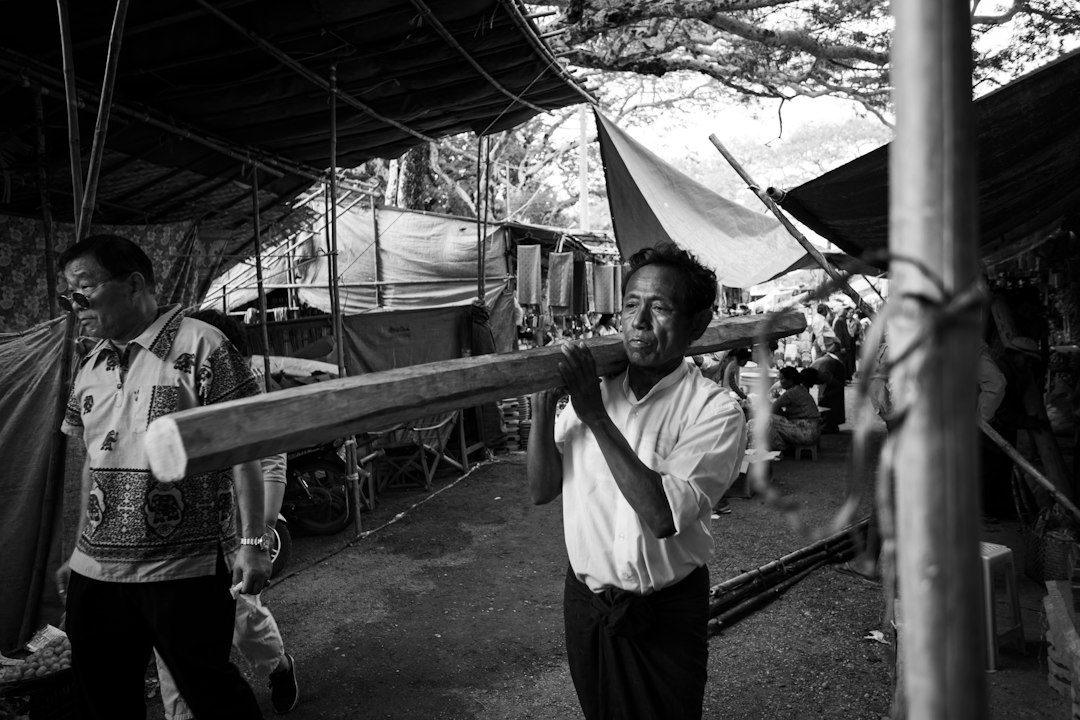
Someone in this market square had asked that same question forty years ago. The one who asked was me. I was sixteen that year. The one who answered said nothing—he hoisted a log in front of the whole city.
II
Yueyang, forty years ago. The autumn harvest just in, the market square loud enough to press voices against voices.
Those were lean years. My father kept this drink stall, and right across from it stood the notice wall. He had a saying: a notice is new the day it’s pasted, and old after a night’s sleep. Old meaning—no one takes it as anything anymore.
That morning, two halberd-carrying soldiers and a market clerk came to the square, hauling a log.
Freshly felled pine, bark half-peeled, pale white, propped against the notice wall. Somewhat over three zhang long, thick at one end, thin at the other.
The clerk had a ringing voice: “By order of the Zuoshuzhang: ten in gold to whoever moves this log to the North Gate!”
Ten gold.
The square went still for a heartbeat, then burst out laughing.
“Ten gold?” bellowed Lao Hang from the crowd. He was a porter, lived off his shoulders. “They couldn’t sell me whole for ten gold!”
“Ten gold to move a log? Even when bread falls from the sky, best check whether it’s drawn on paper first.”
“Far as I can tell, it’s a hook. Hook the dumb fish, then reel in the line.”
“More likely you haul it to the North Gate and they charge you fifty gold for ‘disturbing official property’!”
The louder the jokes, the louder the clerk shouted his order. He shouted until the sun slanted west and his voice cracked, and not one soul moved a step forward.
At the outer edge of the crowd stood a man—not tall, but broad across the shoulders, both arms resting on a carrying pole, and he never once laughed.
His name was Musheng. He too lived off his shoulders. His father had been a porter before him, hauled river-work, died on the river flats. Musheng took up his father’s pole at twelve. Most of the hemp bales no one else could lift, the grain carts no one else could push—they went over his shoulders.
At midday he came to my stall, two bowls of jiangshui, drained to the bottom.
“Aman,” he said suddenly. “Do you believe it?”
“No,” I said. “If bread falls from the sky, it lands on some official’s own pot.”
He set the bowl down and thought. “One log, South Gate to North Gate, half a li. Carry it there, ten gold. Run the numbers any way you like—that’s a loss.”
“So it’s a swindle.”
“A swindle has to profit someone.” He frowned. “One log. What would the government want with it?”
“What we all want—something to gawk at.”
He didn’t answer. He pressed two coins under the bowl, squared them neatly, and left.
III
The log stood in the square for three days. On the morning of the third day the notice changed: fifty gold to whoever moved it to the North Gate.
Fifty gold. Twice as many spectators as the first two days.
“Bigger and bigger,” Lao Hang said, squeezing up to my stall. “Ten gold and nobody believed it, so now it’s fifty. The fish won’t bite—so they’re sweetening the bait.”
“Mark my words,” someone said. “You haul it clear to the North Gate, and they say one line—‘this log was placed by the Zuoshuzhang himself’—and you’re the one owing fifty.”
“Fifty gold?” An old man smacked his lips nearby. “In my whole life the biggest gold I ever saw was the pair of ear-pendants the widow Li was buried in.”
It wasn’t that nobody was tempted. One tall fellow actually pushed up to the log, laid a hand on it to feel the weight—and the crowd went silent as stone. He let go, turned, and slipped away through the gaps between people, and nobody dared ask. A woman dragged her husband backward by his jacket hem for all she was worth: “There’s soldiers standing right there!” She hauled him half a street, him looking back every third step.
Lao Hang was enjoying the show. Musheng came for jiangshui all three days. Two bowls the first day, two the second. The third day, three.
His mother’s cough had been bad those two nights. When he came the third day, there were two shadows under his eyes, and he drank slower than usual.
He worked the numbers with me. “That aged ginseng-root at the apothecary—eighty cash a liang. Mother’s cough, it worsens every winter. Fifty gold—” he held out five fingers, then slowly drew them back, “—enough for her medicine till she’s ninety-nine.”
“Then why don’t you go?”
He gave a small laugh. “Carrying loads takes strength. Carrying this takes something else.”
“What?”
“Haven’t figured it out yet.”
Lao Hang leaned in. “Musheng, you haul thousand-jin bales every day and you’re scared of one log?”
“It’s not the carrying I’m afraid of,” Musheng said. “It’s getting there, and having someone smile and ask—who told you to take it seriously?”
The whole square treated it as a joke. Only he said it flat and even.
That evening old Master Chen came for jiangshui. Chen was seventy; in his youth he’d driven carts for the government, and all his life he’d watched notices the way you watch a play.
“Master Chen, what play is the government putting on this time?”
Chen blew the steam from his bowl. “It’s not that officials are wicked. It’s that their words have never counted. Two years back they promised tax relief—relieved one part in ten, then raised it two parts the next year. Words that don’t count hurt worse than wicked words. Wicked words you can guard against. Words that don’t count—nowhere to hide.”
“And the fifty gold?”
“Bait,” said Chen. “Bait for dumb fish. There’s dumb fish every year—they just won’t bite.”
That night Musheng was the last to leave. He sat by the stall, looking at the log lying pale in the moonlight.
“Aman, tell me—how did the word ‘trust’ get lost?”
“When enough people drop something, no one thinks it a pity anymore.”
“Then how do you pick it up again?”
“One person picks it up, everyone laughs at the fool.”
He nodded, as though tucking those words into his shoulder-bag. “Someone has to be the fool first.”
Before leaving he asked, “If you had fifty gold, what would you do first?”
I thought. “Buy my father a new carrying pole. And three chi of cloth for myself.”
“Three chi of cloth—for what?”
“Shoes. Winter water-hauling—the cloth on my feet is patch over patch.”
He laughed out loud, rare for him, and when the laughter passed, drained the last mouthful from his bowl.
IV
On the fourth morning, just as the square opened, Musheng came.
“One bowl of jiangshui. Hot.”
I told him to pay after. He fished two coins from his shirt and set them on the counter. “No. From today on, everyone I deal with gets paid first.”
Lao Hang squatted at the other end of the stall, cracking roasted beans. “Musheng, a word of advice. What if the government really does welch?”
“Then they welched.”
“And what do you do then? Swing a carrying pole at them?”
“I wouldn’t win.”
“Then what’s in it for you?”
Musheng sipped his jiangshui and said slowly, “Hangzi, think. What if they do pay? They pay, and from then on we can walk under that notice wall without covering our ears.”
Lao Hang fell silent, chewing a bean to a crunch.
When the bowl was empty, Musheng set it down and walked toward the log.
The clerk had shouted his order for four days, lips cracked, and now that someone was actually approaching, he froze first.
Musheng bowed with cupped hands. “This log—I’ll carry it to the North Gate. Fifty gold. Paid on the spot?”
“Paid—paid on the spot.”
“Those words—are they yours, or the Zuoshuzhang’s?”
The clerk straightened his back. “The order is the Zuoshuzhang’s order. I’ve stood here four days. Whatever I’ve said, I’ll stand behind it myself.”
“Good,” said Musheng. “And if you come up short?”
“Short—” the clerk hesitated, “—then you carry the log back to the South Gate for me.”
The square exploded with laughter.
“Good.” Musheng nodded. “That’s fair.”
He crouched, wrapped his arms around one end of the log, weighed it. “Wet pine. Three hundred jin, give or take. Walk with the wind, no stops—under half a shichen.”
A tradesman sizes goods without a scale.
The crowd went still at once. He spat into his palms, bent, set his shoulder against the log’s midpoint, and sank his weight—
The log left the ground.
He swayed as he rose, then steadied. Three hundred jin of pine across his shoulders, trembling faintly at both ends, and the man planted like a nail in the brick ground.
Somehow—I don’t know why—I grabbed my carrying pole, hoisted my jiangshui buckets, and followed. Lao Hang was faster still, snatching up the shoulder-bag Musheng had set down, muttering, “It’s not that I believe in him. It’s he’ll get thirsty on the road.”
V
Musheng carried the log through the market square, and every laugh died.
People ahead parted to either side, parted but didn’t scatter, backing along with him. Half a street followed behind, swelling by the step. A pack of half-grown children raced ahead to the North Gate, shouting all the way: “He’s moving the log! Someone’s really moving it!”
Along the street, shop shutters clattered open. The cloth seller, the blacksmith, the mat weaver—all poured to their doorways.
“He’s mad, that man.”
“That’s Musheng, isn’t it?”
“His mother’s still sick. He dares gamble on this?”
“That’s not a gamble,” said someone in the crowd—no one knew who. “A gamble has no bottom to it. He’s got an order standing behind him.”
A bottom to it. Those words traveled the whole street.
The tall fellow from before was in the crowd, saying nothing, walking half a street alongside. And an old woman came out with a ladle and poured half a ladle of water on the dusty road ahead of him, to settle the dust. Musheng walked over the wet mark without pausing, the log steady on his shoulders.
Halfway there Lao Hang caught up, panting. “Listen, Musheng—if you’ve gone and played the government’s dumb fish, I’m keeping this bag for myself!”
Musheng laughed without straining his shoulders. “There’s a dry flatbread in it. Eat.”
At the North Gate, a half-circle of people already waited; news travels faster than feet. The clerk stood ready at a table, and on the table, a wooden chest.
Someone in the crowd said, low: “The Zuoshuzhang.”
The man who came wore a plain black robe, no umbrella, no carriage, just two attendants. All the street’s noise, at this point, was cut clean through, as if by a blade.
He came to the table and opened the chest. Gold cakes, laid out one by one—ten to a stack, five stacks. Golden yellow in the sunlight.
“Count them—he’s really counting them,” someone whispered.
“Ten to a stack… five stacks…”
“Fifty cakes,” said the Zuoshuzhang. “Not one less. Count them yourself.”
Musheng wiped his hands on his jacket twice before reaching out. He picked up one cake, set it back. His throat moved.
“Sir—let me count three or five. That’s enough.”
“Why not count all of them?”
“Counting them all,” Musheng said, “it might feel like a dream.”
Someone in the crowd started to laugh—and halfway through, lowered his own head.
The Zuoshuzhang studied him. “The order says fifty gold. If you have some other hardship, you may speak of it today.”
“The order says fifty gold,” said Musheng. “Fifty gold is enough.”
The Zuoshuzhang looked at him a while longer, then nodded. “Good.”
Then he turned to face the whole street.
“The log,” he said, “is not worth fifty gold. Just now he walked it from the South Gate to the North Gate—and you followed him all the way. What were you following to see?”
No one answered.
“It wasn’t the log you were waiting for. You were waiting for the government’s word to count—just once.”
Under the North Gate it was so quiet you could hear the damp on the log drying, bit by bit.
“From this day,” said the Zuoshuzhang, and his voice was not loud, “when the government gives its word, it plants a log. Whether you carry it is up to you. Whether the word is honored is up to the government.”
He left. No carriage still, two attendants beside him, walking out through the path the crowd opened.
The gold went into a cloth sack, and the clerk himself tied it to Musheng’s shoulder. Half a street along, someone suddenly shouted: “Musheng! Well done!”
The whole street rang out.
Old Master Chen had arrived at the North Gate at some point, leaning on his staff, and had spent a long while squatting by the wall. He said one thing: “From now on, a man had best learn to read these notices properly.”
“Master Chen, you can’t read,” someone reminded him.
“Then I’ll hire someone to read them aloud!” Chen said. “Read them to the whole street—let’s see who dares go back on their word after this!”
The street laughed again. But this laughter was not the laughter of four days ago.
Musheng carried the gold up to me. “Aman. The jiangshui money.”
“Put it on the account.”
“Then you’d better believe I’ll pay.”
“From today, I believe it,” I said. “From today, everyone in this square believes.”
VI
Musheng’s mother had a good winter that year.
The medicine was paid for that same day; half a jin of aged ginseng root, weighed out. The old woman’s cough cleared up entirely by spring. The rest of the gold Musheng wrapped in cloth and tucked beneath his mother’s pillow. The old lady said it felt safe there, and she slept deep.
Fifty gold landed on him, and Musheng went on hauling as ever.
“Fifty gold in hand—why still haul?” I asked him once.
“Hauling’s a habit. Stop, and my back aches.”
“What’s it for, then?”
He chewed the roasted beans from my stall, thinking a long time. “Aman, I used to think carrying loads was a matter of strength. Walking that log from the South Gate to the North Gate, I finally understood: a person keeping their word to you is worth more than strength.”
He spat the bean hulls into his palm. “From now on, when I give my word, it has to be like that log. Once it’s said, it has to stand.”
He kept that promise. That twelfth month, the grain house in the west of the city had to move three hundred bales of millet across the river before it froze, and hired Musheng—delivery agreed for three days. The next day heavy snow fell; the riverbank slope was too slick for a donkey to stand. By dusk on the third day, three hundred bales of millet stood on the far bank, not one short. The manager, embarrassed, offered extra pay. Musheng waved it off. “The number we agreed on. What’s agreed is what stands.”
The next year Musheng married the girl from next to the apothecary. The wedding date had been set the previous twelfth month, and on the day of the feast, half the market square turned up. Someone teased him: “Musheng, even your wedding day runs like an official order—said to be the day, and the day it is!” Musheng scratched his head. “Once a date is set, how could you move it?”
After that, a new custom took root in the square: for any work done with Musheng, he set the price—work first, pay after, no deposit asked. Why? Lao Hang answered for everyone: “His word is a log.”
His mother came often to sit in the sun at my stall. Once the old lady said, “His father died early. I raised him alone, and my one fear was that the boy would learn to be slippery. That day he carried the log past my door, I watched through the crack—” she gazed toward the South Gate, “—this time, he carried his back straight.”
My father died that winter. Before he died, he would often sit by the stall listening to the sounds of the market. One day he said suddenly: “I’ve kept this stall thirty years. That was the first time I ever saw the words on a notice treated as words.”
VII
What came after came one year at a time.
Notices multiplied year by year. Land measured fairly, plowing and weaving rewarded, county clerks going village to village with little notebooks in hand—write it down, and then actually come back and do it. At first people still crowded the notice wall to gawk; later it became part of daily life, as ordinary as reading the weather before a harvest.
My stall changed too. Regulars set their coins on the counter and took their own bowls; I didn’t need to look up. The first trade in the whole market where goods changed hands first and payment came three days later—well, that was Lao Hang cheating me out of two bowls of jiangshui. The day he repaid me he added two coins, said it was interest. I gave them back: “Old debt, paid as agreed. The number we settled on.”
In the sixth year, the capital moved to Xianyang. Some in the square moved away; some stayed. My stall never moved. The spot by the South Gate—once, a log had stood there.
Two years on, a great drought. The notice said the granaries would open and grain be sold at fair price. Lao Hang, as ever, laughed first. Before the laugh died, grain carts were rolling out of the granary doors. Lao Hang’s laugh stuck in his throat. He crouched beside a cart, gazing at the bales as though they were some rare marvel, watched a long while, then stood, dusted off his trousers, and got in line.
Later still—one autumn a wind swept through the city: the Zuoshuzhang had been convicted of some crime, and had not met a pretty end.
For days after, people in the market square kept their voices low.
“It’s over,” someone said. “That breath of ‘taking words seriously’—it’ll scatter now.”
“If the laws are scrapped, we’re back where we started. Back to the days of notices pasted over notices.”
The city held its breath a few days—and the notice announcing fair-price autumn grain went up as always. On the appointed day the granary opened as always; the price was one cash more than fair, not one cash less. No one came to tear down old notices; no new order fell through.
Lao Hang slapped his thigh. “Afraid of what? The government’s never gone back on the word of one log—would it go back on half a bowl of your jiangshui?”
The whole square laughed again. And under this laughter there was solid ground.
Master Chen came often to my stall in those days. “Aman,” he said, “I told you once: words that don’t count hurt worse than wicked words.”
“I remember.”
“I spoke too soon.” He blew the steam from his bowl. “Whether words count is half up to the one who speaks, half up to those who believe. When enough people believe, even the ones who’d like to go back on their word—it becomes hard to.”
I’ve thought often since: that log must have rotted away long ago. But the day it stood upright, the whole city saw with their own eyes, once: the government’s word could be trusted.
Having seen it once, there was no going back.
VIII
“And then?” Xiaosu had finished listening, and wanted more. “What happened to the man who carried the log?”
“Kept hauling, till he was old,” I said. “His grandson still drives a cart outside the North Gate. In the market square, when his family speaks, people accept it. Why? His children grew up on one sentence: a word given is a log set upright.”
“Will the books write about him?”
“The books write mostly about the great,” I said. “The man who carried the log is written in the hearts of us stall-keepers.”
Xiaosu thought, then asked again: “Granny, what did Grandpa Musheng get out of it?”
“He got us this—that now we can walk under the notice wall without covering our ears.”
“And what if the government hadn’t paid that time?”
“Then this market square today would still be one long joke, and you children would still walk with your ears covered.”
“And because they paid?”
“Because they paid, we have today.”
At midday on the tenth day, the new canal truly opened.
The day the water reached the fields, the man who’d laughed loudest of all at the notice crouched by the channel and watched a long time. That evening he came to my stall for jiangshui, and halfway through the bowl he said: “Granny Man, isn’t it strange. The water came into my field, and I felt—well, a little ashamed.”
“Ashamed of what?”
“Laughing at their words. Laughed for nothing.”
“Not for nothing,” I said. “Next time a notice goes up, don’t laugh first. Step closer and learn two characters.”
He chuckled, laid three coins on the counter, and poured himself another half bowl.
Xiaosu had crouched by the stall listening all afternoon. At dusk he suddenly held out his hand. “Granny, a piece of malt candy.”
I thought it was for himself. He stuffed the candy in his shirt and bolted—then turned back at the edge of the square to shout: “Dunzi’s still waiting! I promised him the other day!”
I watched him run. This child—he runs fast. A promise made overnight already feels too long.
Dark settled in, and I closed the stall. On the counter lay several coins, paid in advance—my regulars’, for tomorrow morning. Forty years ago, Musheng pressed two coins on my counter and said that from that day on, everyone he dealt with got paid first.
Forty years. And more and more people pay first.
Whether the government’s word can be trusted—that’s what Xiaosu asked me. I didn’t answer.
I didn’t need to.
The coins stacked square and neat, glowing faintly in the moonlight.
This story is a literary adaptation of the historical episode “Moving the Log to Establish Trust” recorded in the Records of the Grand Historian, Biography of Lord Shang. All characters are fictionalized.
Based on a true story