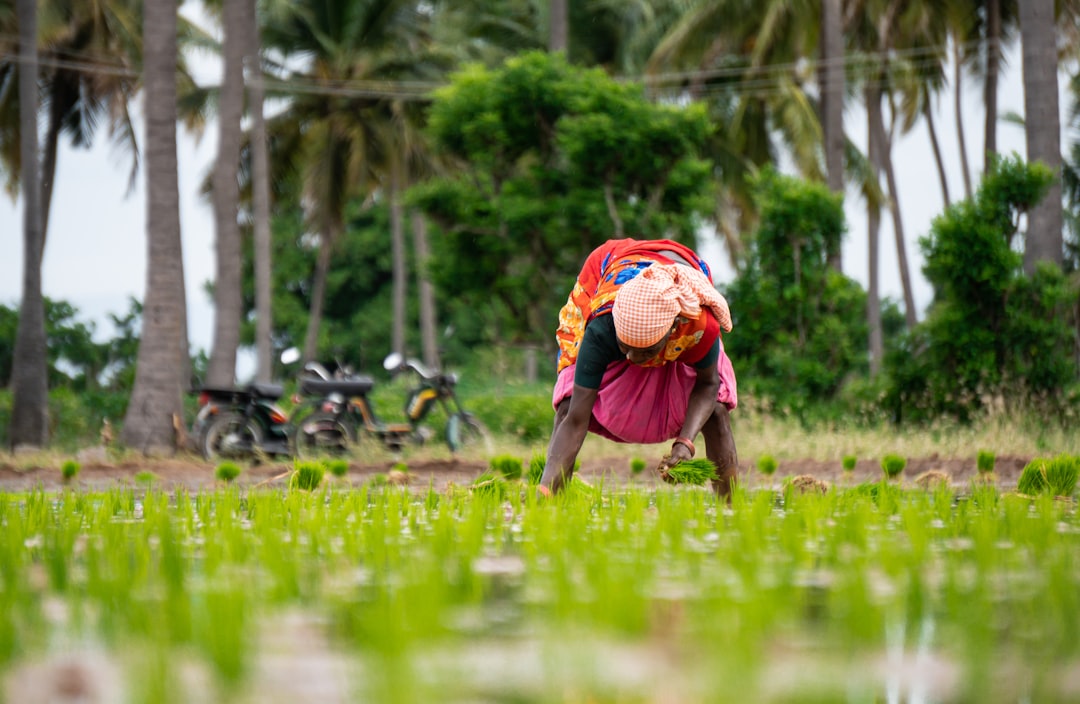
The Man Who Brought the Harvest
I
On a foggy morning in October, I was pulling barnyard grass from my seedbed.
The fog had drifted over from the pond at the east end of the village, moving low along the rice ears, moving slowly. The late rice had filled with grain; the ears bent under their own weight, every one of them heavy. Dew dripped from the leaf tips onto the back of my hand—cold. I squatted in the field, pulled up a few stalks of grass, then, out of habit, grabbed a handful of soil, crumbled it between my fingers, and brought it to my nose. This habit was left over from those eight years; I never broke it. Guifen called from behind for me to come in and eat. She called twice, and when I didn’t move, she said: “There’s a mail truck at the gate. A wooden crate—they say it came from Africa. Took over two months to get here.”
The soil was still between my fingers.
The crate sat on the square table in the main room, the slats nailed on crooked, the corners bound with straw rope, a few colorful stamps pasted on top. Xiangyang pried it open with a screwdriver. Inside was wood shavings, and beneath the shavings, wrapped square and tight in a large print cloth—a red ground printed with yellow and green flowers, the kind of cloth the women there wrap around themselves. I recognized it. Chief Mwalumu had given me one just like it.
I unwrapped the cloth, layer by layer.
First my fingers found a sickle. New, the blade dark and gleaming, the wooden handle wound with strips of cloth in three colors—red, yellow, green. Beneath the sickle pressed a small cloth pouch, tied tight, rustling when shaken upside down. Rice seed. Beneath that, a stack of photographs, and a letter. The characters on the envelope were crooked, wobbling stroke by stroke—traced in Chinese with a brush, traced with such force the paper had gone fuzzy at the edges:
For Teacher Li Shoutian.
I opened all the doors of the main room to let in the morning light, sat down at the square table, and looked at everything, one piece at a time.
II
First, the sickle.
My old sickle was forged at the blacksmith’s in town in the year 2000. I used it until 2014; the blade had been ground down to half its original width, the wooden handle blackened by the sweat of my hand, and it fit my grip just right. That year, just after New Year, Old Zhou came pedaling his big old bicycle to my house. Before he was through the door, his voice arrived first: “Shoutian, there’s something—a matter of enormous importance, or possibly a matter of no importance at all. But you have to hear me out.”
Old Zhou was the retired head of the county agricultural station. Back when the county ran training courses for farm technicians, he had been my teacher. I’d left school in the second year of middle school, at fourteen, to earn work points; later I became the production brigade’s farm technician, and after the land was divided to households, I farmed my own dozen-odd mu. In the countywide rice yield competition, I once placed third. Old Zhou said the province had an agricultural assistance program abroad, in Tanzania, in the Morogoro region—tens of thousands of mu of fields. The soil there was good soil, black and rich as oil, but the harvest failed year after year. A team of experts had been brought in at great expense, and after two years of struggling, the plans on their blueprints never touched the ground; the fields lay fallow as ever. Someone there had put out the word: you people with your blueprints are no good—can you find someone who has farmed the land his whole life and let him try?
Old Zhou said: “In the whole province, you were the first person I thought of.”
That night Guifen said nothing, just darned my socks by the lamp. When she finished one, she said: “Go. A man like you—if you don’t go see that field, you won’t sleep soundly for a whole year.” My son Xiangyang objected: “Dad, you’re almost sixty. Flying that far.” I said: “I’m not going to enjoy myself. I’m going to look at a field. Fields everywhere grow about the same, and the reasons a field does poorly—there are only a few, turned over and over.”
I packed my woven plastic sack. Three things inside: that sickle I’d used for ten years; a small iron pot—Guifen had stuffed it in, saying I wouldn’t get used to the food over there, and when I was homesick I could cook myself something hot. And two packets of rice seed, conventional seed saved from our own field, wrapped in newspaper and tied three times in plastic bags. At security check, they dug the seed out and examined it for the longest time, unable to understand why I’d flown over ten thousand kilometers and wouldn’t let go of two packets of grain.
Two flights later, I landed in Dar es Salaam. Then west by road; the asphalt gave out into dirt, and the dust the truck kicked up was red, hanging in the air half the day. When we reached the village edge it was evening, and a crowd of barefoot children chased the vehicle, their laughter louder than the wheels.
The first thing I did when I got out was go look at the fields.
The fields spread out beyond the village, flat as a threshing floor, the black soil soft underfoot. But a layer of dead water lay gleaming on them; the rice grew in scattered clumps, some thick, some thin, the leaf tips yellowing, whole clumps toppled over. I squatted and squeezed a pinch of mud, and my heart settled.
The next morning, the whole village came to see me. They looked at my plastic sack, pulled out the sickle, and laughed, chattering all at once. A young man held up my old sickle for everyone to see, and the laughter grew louder. Later, Yovu told me what they’d said: their grandfathers’ grandfathers had used that thing; the old Chinese man had crossed the ocean and all he brought was something from the time of his grandfathers’ grandfathers.
Yovu was a young man of the village who had been to secondary school, twenty-three years old, spoke English; the district had assigned him as my interpreter. I had Yovu translate my words: “They laugh rightly. When it comes to playing with fancy machines, I’m no match for them. But when it comes to serving rice—let’s see how we do, from here on out.”
I imitated their gesture, spreading my palm open, then slowly closing it into a fist. The laughter gradually died down.
III
For my first three days there, I did no work at all. I just squatted.
Squatted on the field ridges, handling rice seedlings. Pulled one up: the roots were yellow, rotted at a pinch, giving off a fishy smell. Good rice roots are white and strong, springy in the fist. The roots in this field had been spoiled by sitting in water.
I rubbed the soil. Compacted—it wouldn’t hold together in a ball, wouldn’t crumble either; all the air channels were sealed shut by the dead water.
I had Yovu ask why the water wasn’t drained off. The answer: the rainy season lasted only a few months, the dry season stretched long; water stored in the fields was kept there to save their lives.
Something stirred in me. They weren’t lazy. They were afraid. They had been afraid for generations, until fear had become their way of farming. You couldn’t blame them for that—it only meant the key was still missing.
I asked Yovu to carry my words to the elders: “Water is a treasure, but water needs a road too. A man who holds his breath too long suffocates; a field is the same. Dig the channels, and in the rainy season the water can leave, and in the dry season you can hold it in.” The elders squatted in the shade of the trees and deliberated a long while, passing a pipe around. Finally a white-bearded old man spoke: All right—we’ll give you half a field. If you ruin it with your channels, you pack your bedding and go home yourself.
I went to the fields at five in the morning. For the first three days, just me, one shovel, cutting channel after channel, row by row. The blisters on my hands broke and healed, healed and broke. On the fourth morning, in the gray light before dawn, someone was squatting on the ridge—Baraka. The same young man who’d whistled and jeered from the treetop those first two days. Nineteen years old; his mother had died early, his father worked in Dar es Salaam, and he lived with his grandmother, three mu of family land. He had watched me for three days from the ridge; on the fourth, he jumped down, snatched the shovel from my hands: “My turn.”
His channels came out crooked, deep in one stretch, shallow in the next. I taught him hand over hand: the line must be pulled straight, the bottom must be level, only then will the water obey. He grumbled, unconvinced. I mimed it for him: water is like a person—if the road is rough, it throws a tantrum. He dug half a channel, looked back at mine, then at his own, said nothing, and went back and redid it.
Two weeks. Three main channels. The day we let the water out, the whole village stood on the ridges. I broke open the breach; the dead water found its road and went rushing down the channels, spiraling, running all the way to the low ground. Someone crouched down and put a hand into the flowing water as if learning for the first time that water could be cold.
From that day on, whenever I squatted on the ridge rubbing soil between my fingers, there were always people standing behind me. Three at first, then thirty. One day when the sun was brutal, a woman with a baby on her hip silently handed me a gourd ladle of water. I drank it and nodded to her. She couldn’t speak my language, I couldn’t speak hers, but we both understood.
IV
As for that small cloth pouch in the package, I untied the string and poured it into my palm. Plump grains, bright gold, heavy in the hand, every one. Seed they had bred themselves.
I picked out two grains and chewed them.
And as I chewed, I smiled. In 2014, the first time I brought out my own rice seed, a villager had done just this—pinched up a grain, chewed it, spat on the ground, and shook his head. I understood: your grain isn’t as sticky as ours.
But rice isn’t judged by the mouth. It’s judged by the field.
That year, after the water was drained, I led them in preparing the land and pulling the lines. For the seedbeds we first built shelter frames: bamboo strips bent into bows, covered with old plastic sheeting, against birds pecking and rain hammering. On sowing day, the whole village came to gawk, saying it looked like building little houses—rice isn’t babies, after all. I said rice is babies. The water in the seedbed changed once a day; the temperature under the frames, tested by reaching a hand inside. Several old men nearby just shook their heads.
For transplanting, I taught them to pull cords to mark the spacing, rows straight across and down, measuring plant distance and row distance with the palm of the hand. There was a woman called Mwanisha, impatient by nature, who thought pulling lines too slow; while I was away, she flung chemical fertilizer into the field by the fistful, and the next day a patch of seedlings had wilted—burned. She crouched at the field edge crying. I had her flood the field through the night to dilute it, then top-dress with well-rotted farmyard manure to press it down, and we saved most of it. From then on, Mwanisha became the most conscientious person in the village—the first to come hammering at anyone’s door who scattered fertilizer carelessly.
Weeding took even more teaching. They couldn’t tell barnyard grass from rice seedlings, so I made up a rhyme and had Yovu translate it into their language; where translation failed, I took them to the field to see: Barnyard grass leaves gleam and shine; rice leaves wear a frosty rime. Barnyard roots are white and slick; rice roots blush and never quit. Baraka learned fastest—later he could pick barnyard grass out of a handful of weeds with his eyes closed, and for every stalk he pulled, sing a line of their songs.
I stumbled too. When it came time to sow, I calculated by the Hubei solar calendar, figured I couldn’t go wrong, and didn’t ask around. Then, after sowing, a night rain came pressing over from the far side of the mountain and scattered half the seedbed into ruin. Baraka’s grandmother came leaning on her cane, stood a long while, and said one sentence. Yovu translated it with a white face, not daring to give it straight. The old woman waved her hand—give it straight:
“The rain from beyond the mountain has a temper of its own. It doesn’t read your almanac.”
I stood at the edge of the ruined seedbed and said nothing for a long time. I’d farmed all my life, and for the first time, an old woman of eighty who had never left her village had schooled me clean. From then on, wherever I went, I sought out the oldest person first and asked about the rain, the water, the mountains. Even an old hand must bow to the god of the land—and the god of the land is different everywhere; you have to ask the locals.
That season we made comparison fields. Two mu at the east end of the village: half with the old methods, half with the new, a red cloth strip tied to the stake. Through the rainy season, the side with the red cloth changed by the day, its leaves dark green and glossy; when the wind passed, wave pushed upon wave. The old-method side endured, yellow and thin. At first the villagers watched from a distance; then they came up onto the ridges to watch; later still, people came at night with flashlights to look.
V
The topmost photograph was taken on threshing day. The threshing ground, wooden racks, dozens of people, the grain piles heaped to a peak. The photo is a little blurry—I took it that year with an old camera assigned by the county, and I could never bring myself to mail it back. So Baraka had kept the negatives.
It was late July, the tail end of the rainy season, when the comparison fields were cut.
The old-method side yielded three or four sacks per mu. The red-cloth side, after weighing: twelve and a half sacks per mu. The old scale at the village grain station creaked as it swung, and with every creak the crowd roared. Baraka ran wild across the threshing ground with a sack on his shoulder, and on the third lap plunged headfirst into the grain pile and didn’t move for the longest time. I walked over. He lay flat on his back, his face covered in sweat and chaff, grinning, saying nothing—just grinning.
Old Chief Mwalumu was helped over by two men. Past eighty, leaning on a wooden staff topped with a carved rice ear. He bent, grabbed a handful of grain from the pile, spread it in his palm, blew away the empty husks—and what remained was heavy. He looked at it a long time. Then he took my hand and pressed the grain into my palm, and spoke at length.
Halfway through translating, Yovu’s voice went hoarse: “The chief says in more than eighty years of living, for the first time, he has carried grain from these fields until his arms ached.”
That night, the village held a feast with a whole ox. They raised a bonfire and roasted the whole animal over the flames, and the drums beat from dark until dawn. The whole village danced in circles around the fire, the old ones leading ancient songs—one voice leading, all the rest answering, the song rising layer upon layer, like rain falling layer upon layer. Past midnight, the old chief rose on his staff, and the ground went silent. He cried out one sentence, the whole assembly answered with a roar, and then, cry by cry, in unison, they called out the same thing, over and over.
Yovu, eyes red, told me: the chief had given me a name. In their language: “the man who brought the harvest.”
With every call, I had to answer. I stood there holding a piece of beef in the firelight, tears hissing as they fell into the flames. I had never in my life traveled far; at fifty-nine, I left the country for the first time, and they gave me a name—not because I did anything great. I taught them to dig three channels, pull a few lines, tell barnyard grass from rice. That was all.
The village carried on until dawn that night, but I sat alone on the field ridge until the east grew pale. And I understood one thing:
It wasn’t I who brought the harvest. The harvest had been sleeping in this land all along, sleeping for generations. All I did was dig it a road to walk out on.
VI
The letter was in English. In the evening, Xiangyang took it to the English teacher at the middle school to read to us. The teacher read a sentence, translated a sentence; beside us, the fan in Guifen’s hand slowed, and stopped.
The letter was not long, but the words were heavy.
Baraka is now a technician at the township agricultural station—eleven people there including him. He has taken on twelve apprentices. Yovu graduated from the agricultural college and came home; he runs farm-extension work for eleven villages, and the letter says those eleven villages all eat the new rice now. In last year’s great drought, the other townships’ yields fell; theirs did not. The letter adds: the new roof on the village primary school was paid for with money pooled from selling grain, and on the outside wall of the classroom someone painted a line in their language—guess what it says.
Xiangyang turned the letter paper over. Behind it, someone had long ago penciled in the Chinese. Yovu’s handwriting, neat and careful:
“Dig the channels well. Teach the people well.”
Those were my words. In those years I said them every day until they were sick of hearing them, and they’d mimic my accent saying them, and the whole room would laugh. I never imagined they’d painted them on a wall.
I turned the photographs one by one. Golden waves of rice, rolling all the way to the foot of the hills. Grain spread on the threshing ground, children squatting at the edge of the piles, throwing victory signs. The last photograph: Baraka and his twelve apprentices, standing in two rows on the field ridge, straight across and down, standing like lines I had once pulled.
I remember how those eight years passed.
The second year, people from neighboring villages came asking to learn. I didn’t go. I sent Baraka, Yovu, Mwanisha—they went to teach. I told them: teaching people works just like raising seedlings. The seedlings in my shelter have to be transplanted by you into the open fields. Growing in my shelter alone, they’ll never make a second field.
The fourth year, Yovu was admitted to the agricultural college in the provincial capital, his tuition pooled by the whole village—Old Chief Mwalumu led the drive, and I added half of the subsidy money I’d saved. The day he left, he carried a woven plastic sack on his back—the one I’d given him, exactly like the one I’d carried myself.
The sixth year, Guifen needed gallbladder surgery. I watched through the video call as she drank her first bowl of rice broth after the operation. She waved at me: “I’m fine. Teaching people to eat their fill is proper work.” I turned my face away so she wouldn’t see. An old man’s face is a face too.
The seventh year, people from the county TV station flew over to film me. The reporter asked: Master Li, what’s in it for you? I squatted on the field ridge, wiped the mud from my hands onto my trousers, thought a good while, and said:
“Land has no borders. If the people who farm it can eat their fill, it’s worth it.”
In the eighth year’s rainy season, my back caught a chill; I squatted down and couldn’t get up for the longest time, and it was Baraka who carried me back to the house on his back. That boy was twenty-seven that year, his shoulders wider than a doorframe. Just then the new batch of technicians arrived, and Old Zhou said over the phone: Shoutian, your work is done—come home with honor. I said it wasn’t that my work was done; it was that these old bones of mine needed to come back and keep my own field.
The day I left, the whole village walked me to the dirt road. Drums the whole way. Old Chief Mwalumu could not come; he had passed the winter before. His grandson chased the vehicle down and pressed something into my hands: the carved rice ear from the head of his grandfather’s staff, sawn off, polished smooth. My plastic sack had been stuffed full by the villagers until the zipper wouldn’t close—then they took everything out again and replaced it with a single sheet of paper, written by Baraka. What was on it I couldn’t read at the time. After I got home, I had it translated. Just one sentence:
“Teacher Li said: fool the land for a season, and the land fools you for a year; cherish the land all your life, and the land feeds your line for a hundred generations.”
VII
That day, after lunch, I did three things.
First, I hung the new sickle on the wall of the main room. I brought out the old one too, and hung them side by side. The letter said this about the old sickle: we had the blacksmith in town make the new one, and wound the handle with red, yellow, and green cloth—the colors of our flag; and as for your old sickle, the one you used for ten years—we did not return it to you. We hung it on the beam of the village committee house, beside the chief’s drum. When the children ask, we tell its story.
Second, I sent Baraka a video reply. Xiangyang held the phone while I sat at the door of the main room and said to the camera what I wanted to say: the seed arrived, and it’s good—every grain heavy in the hand; have the apprentices clear the channels every year and pull the lines every year; those words on the wall are worth more than any certificate. And last, I spoke into the phone the one sentence of their language I had spent over two months learning. My pronunciation was surely a wreck; Xiangyang was biting back laughter beside me. I glared at him: what’s to laugh at? What they’ll hear is the heart.
Third, I took a handful of the new rice seed and put it into my own field.
In the evening I went back to the seedbed. The fog had long since lifted; the tips of the late rice had yellowed, and when the wind passed, the whole field of ears nodded. I squatted down, first crumbled some Hubei soil between my fingers, then gently scattered the Tanzanian seed from my palm over a small patch of freshly turned earth and covered it with a thin layer of soil. Next year at Grain Rain, I’ll try raising seedlings. If they live, I’ll divide them among a few village households to plant. If they don’t, I won’t blame the seed—I’ll blame myself. The soil is different; I’ll just tend it slowly. I have nothing but patience—those of us who work the land have no other wealth, but patience we have in plenty.
My grandson Xiaoman came home from school and squatted beside me, watching me work the mud, and asked: “Grandpa, what did those people over there call you again?”
I said: “The man who brought the harvest.”
“Then you’re a great man.”
I laughed, spat into my palm, and rubbed my hands: “No. The harvest grows from the land; a man only shows the harvest the way. I dug the channels, I pulled the lines, I told the barnyard grass from the rice—so if you ask me, I’m just a man who dug channels.”
Xiaoman half understood. Dusk was falling; the mist was rising off the fields again, a white wash drifting low along the rice ears, moving slowly. I squatted on this side and thought of that village ten thousand kilometers away—about now, the fog would be rising there too, and it would be drifting low along their rice ears, moving slowly.
All the earth under heaven has one ancestor, and all the rice under heaven one mother. Push your hand into the soil: cool on top, warm beneath—the soil is the same everywhere.
I brushed the mud from my trousers and, pushing on my knees, stood up. Next spring, Xiaoman and I together will take that new sickle with the three-colored handle to have its edge ground.
Its first cut will fall in a Hubei field.
(The End)
This story is adapted from true events. All names are pseudonyms.
Based on a true story