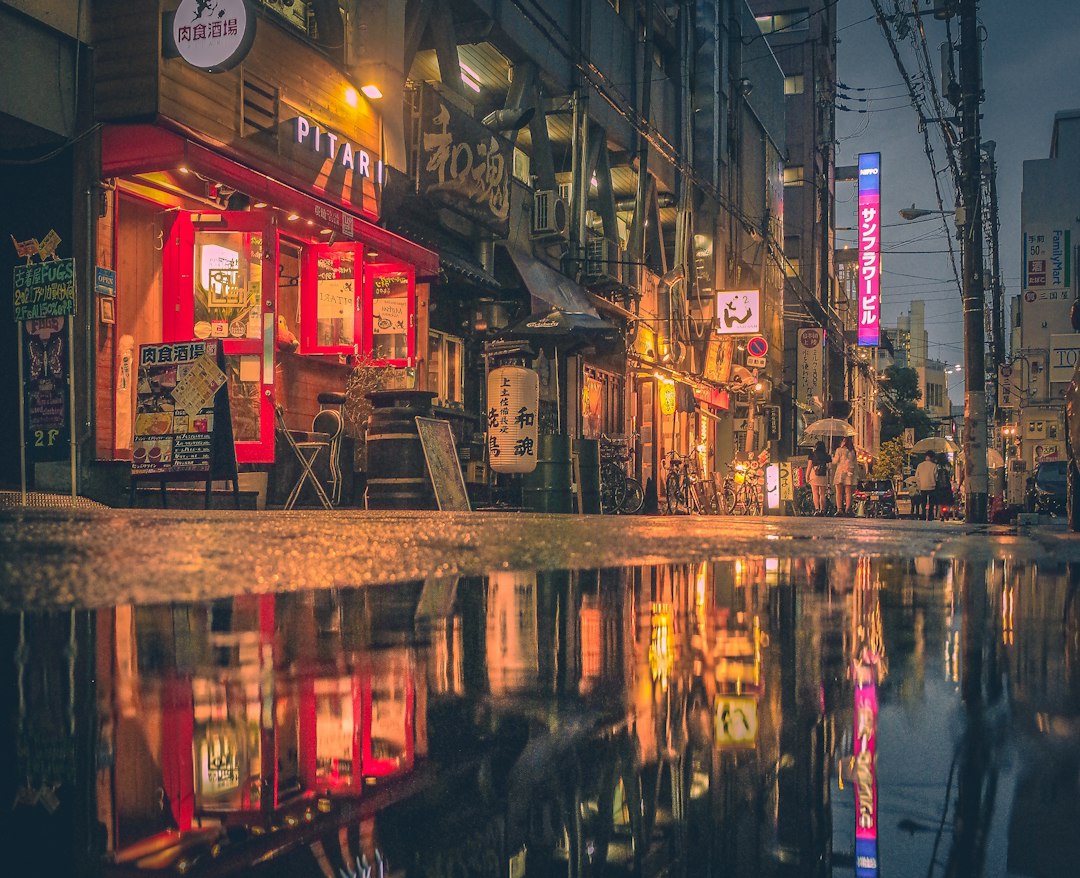
All the Lights on the Street Were Burning
One — Sunday, July 18
The suitcase had stood in the corner for three days. Its zipper was half open, revealing a pair of white sneakers still sealed in plastic—bought on sale last November, ones he’d figured he’d never wear back in his hometown, so he’d left them untouched.
Zhou Ye crouched down to press the case flat. It bounced back up and knocked him off balance. The twenty-six-inch case held everything he’d accumulated in this city: two comforters, a stack of overtime punch-clock records, half a box of design sketches he couldn’t bear to throw away.
Outside the window, the sky hung gray like a dishrag that wouldn’t wring dry. The forecast said the rain would last a week. He glanced at his phone: July 23, a slow green train, hard sleeper, lower berth, back to southern Jiangxi. Three years. More than a thousand days. Wrapped up in a 180-yuan train ticket.
He had lived in this fifth-floor rental for three years, and in all that time, not a single person had ever set foot inside.
The time he ran a high fever, he’d hailed a cab to the hospital alone at midnight. While the IV dripped, the old man in the next bed had a daughter peeling apples for him, and the whole room smelled of apples. Zhou Ye clutched his payment slip until his palm went sweaty. The day he’d moved in, the delivery man who hauled his suitcase up five floors charged him sixty yuan and chatted the whole way about the navel oranges from his hometown—the most anyone had spoken to him in three years.
At his office tower, the last light to go out each night was usually his desk. He’d switch it off, take the stairs down, dissolve into the crowd, and not one window on the whole street glowed for him. He’d had one drink with a coworker, Xiao Jiang, and after one too many, let it slip: “This city looks packed with people, but it’s like there’s nobody here at all.”
Xiao Jiang told him: a poet’s soul in a wage slave’s body.
In three years of Zhengzhou, he’d learned exactly one word of the local dialect: zhong—roughly, “you bet.” And he’d never once had a proper chance to use it.
That night, he opened the diary in his drawer. His mother had forced him to keep it since third grade, and he’d written in it ever since; it was his only correspondence with himself. He uncapped his pen and wrote:
July 18. Clear. Nothing.
He closed the book. Those three words he had written for three years.
Two — Monday, July 19
The rain started in the small hours. At first it kept some semblance of manners, pattering politely—but come dawn it cut loose, bucketing down as if the sky had split.
No one worked in the office; everyone crowded at the floor-to-ceiling windows to watch. Raindrops hammered the glass like someone outside swinging drumsticks. Xiao Jiang shook out his umbrella: “Word is, this rain runs through Thursday.”
“Let it rain,” Zhou Ye thought. “When it’s done, I’m gone.”
By quitting time it was worse. Xiao Jiang stopped him at the elevator: “Before you go, you’ve got to have one bowl of hui mian. Farewell dinner.”
“Haven’t finished packing.” He waved a hand.
He had finished packing long ago. He planned to say goodbye to this city the way he’d arrived: silently, as if he’d never been.
That night he called his mother. She asked, did you get the ticket? Yes, he said, for the twenty-third. When you’re home, she said, I’ll make you ai mi guo. He said good.
He hung up and opened the diary:
July 19. Heavy rain. Packed up.
Two lines. One more than yesterday.
Three — Tuesday, July 20 (Part One)
At four in the afternoon the company chat exploded: Rain’s too heavy—everyone go home early! Get out while you can!
Zhou Ye packed his bag and headed down—only to find the sky already black. Not nighttime black, but black like a pot upended over the city. The streetlights clicked on with a snap. At four in the afternoon, every light in town was burning.
The subway station’s shutter was down, the display flashing one line: Full line suspended. The bus stop sat drowning in water. He did the math: five stops to his apartment, about forty minutes on foot. Walk. Wade home.
The water passed his ankles, then his calves. By the third intersection it wasn’t falling anymore, it was hurling itself down; his umbrella flipped inside out within two minutes, so he stuffed it in his bag, one arm shielding his backpack, the other groping forward.
At the intersection ahead the water was up to people’s thighs and swirling hard. Four or five men stood in a line, arms linked, locks of flesh, acting as living posts, shouting hoarsely toward him:
“Get your footing before you step! Hold our arms! Don’t let go!”
His turn. A hand clamped his wrist with the grip of pliers. He looked up: a crew-cut young man in a white tank top, soaked through as if dredged from the river, shoulders wide enough to park a bicycle on.
“Hold on tight—got it?” the young man shouted.
“Got it—zhong!” He heard himself shout the first word of Zhengzhou dialect he’d learned in three years, loud and smooth, as if he’d rehearsed it a hundred times.
Halfway across, beside a stranded white car, the current spun hard. His foot slipped, his whole body pitching forward—
“Steady!” The young man hooked an arm around him, then crouched. “Climb on!”
The instant Zhou Ye lay against his back, he felt a heart pounding through it, steadier than the thunder overhead. He weighed a hundred and thirty catties; the water slammed against the young man from both sides, and still each step came down like a nail driven home.
“Name’s Tian Zhuang. Fitness coach. Live in the complex up ahead.” He shouted without turning his head. “Ain’t nobody getting home tonight—same boat! Same boat means we’re all fine!”
Four — Tuesday, July 20 (Part Two)
Farther on, the water crept over the storefront steps. The whole street was dark except for one little noodle shop, its door glass papered with a sign, the characters crooked but written with force:
Come in out of the rain. Hot water here.
Zhou Ye and Tian Zhuang waded over and pushed inside; a wall of steam hit their faces. A dozen-odd people were already packed in, umbrellas and shoes strewn everywhere. At the stove stood a man of about fifty, apron soaked to the waist, voice louder than the rain:
“Door’s shut! Nobody leaves tonight! Everybody sit!”
He was Uncle Lei. The shop was closed, but he boiled every noodle he’d prepped, then set a second great pot of ginger soup on and ladled it out bowl by bowl. “Drink! If there’s warmth in your belly, there’s no panic in your heart!”
A girl with a ponytail circled the room holding her phone up hunting for signal, asking each person in turn, “Uncle, Auntie, what’s your family’s number? Let me try—my two bars might just get a message out!” Her name was Xiao Man, a junior in college. A young mother with a baby gave her the number; the call connected, and at the first word from the other end the tears came. “Mom, I’m fine, the baby’s fine, we’re in a noodle shop, the owner’s so kind…”
Old Dai, the melon seller, crouched in the corner, his three-wheeled cart soaking across the street. He got up, waded out, dragged back two melons, and split one with a knife: “Waterlogged—can’t sell ‘em. So eat ‘em!” The melon was sandy-sweet.
Past ten, water crossed the shop’s threshold—ankle-deep, still rising. Just as panic set in, the owner of the little guesthouse across the street shouted through the rain curtain: “Quit standing there! Up to my second floor!”
The whole group waded across. They bedded down in the corridor; there weren’t enough blankets, so Uncle Lei’s wife lowered two out the window on plastic bags, and the guesthouse owner tore up spare sheets. A row of strangers lay on the floor, feet to feet, none knowing the others’ names.
Zhou Ye’s phone had seven percent left. He sent his mother four characters—“I’m safe”—and didn’t dare switch it on again. Under the dim emergency light, sleepless, he fished his pen and diary out of his backpack.
For the first time in three years, he wrote at length. He recorded, one by one, the names he’d learned that day: Tian Zhuang, Uncle Lei, Xiao Man, Old Dai, the guesthouse owner, the young mother and her sleeping baby. Stroke by careful stroke, like drafting a blueprint.
July 20. Rainstorm. Today the water drowned half of Zhengzhou and surfaced something else. I’m writing down these names. I’m afraid I’ll forget. Something this big, people this good—mustn’t forget.
When he looked up, through the corridor window he could see the noodle shop across the street still lit—and every storefront on the whole street lit too, not one closed for the night. Uncle Lei sat in a raincoat on a folding stool at his door, keeping vigil, it seemed, for the whole street.
Zhou Ye thought of three years of two-word diary pages, and his nose suddenly stung.
Five — Wednesday, July 21
Dawn broke clean. The rain had stopped, the sky so blue you’d think nothing had happened—only the knee-deep muck in the streets marked how far the water had reached.
Zhou Ye didn’t leave. Tian Zhuang came banging on his door early: “Come on—hauling water!” And he went.
At the intersection, volunteers had gathered on their own. Vans ferried in bottled water trip after trip—some unloading, some sorting, a loudspeaker calling out which buildings lacked water, which had elderly people who couldn’t come down. Zhou Ye hauled all morning until his shoulders were rubbed raw.
In the afternoon, people crouched at the curb, fretting: who needed what, in which complex? Nobody could say. Zhou Ye’s eyes lit. He pulled out a notebook and pen and drew a hand-drawn map: red for roads cut off, yellow for supply points with water and power, blue for buildings desperate for goods—one page, everything clear. He photographed it and posted it to the volunteer group; overnight it spread through half the city. Someone replied: “Delivered exactly where your map said! Thanks, brother!”
Xiao Man wasn’t idle either. She built an online spreadsheet—who was trapped, who needed medicine, who could offer a place to sleep—logging every entry. “I can’t haul anything,” she said, tapping away, “but I type fast and my eyes are good.” Two hundred–plus entries by morning.
Uncle Lei set his big pot up again, right outside the shop, cooking noodles for free. Some, feeling guilty, tried to scan and pay; Uncle Lei’s eyes bulged: “What’re you doing! Pay again and we’re through!” The man had no choice but to sit back down and eat two bowls, one after the other.
At noon Zhou Ye ate noodles crouched at the curb. Tian Zhuang handed him half a bottle of water and sat down beside him. “Brother, that map of yours did more good than me hauling all day.”
Zhou Ye grunted and bent to his noodles. Then he realized he’d been smiling all afternoon—his cheeks ached from it. For the first time in three years, the curb of this city felt warm beneath him.
That night, the diary:
July 21. Overcast. Hauled 2,400 bottles of water today. Drew one map. Ate two bowls of noodles. Two blisters on my hands. Feels damn good.
Six — Thursday, July 22
Power came back, the supermarkets reopened, excavators rumbled through intersections clearing sludge. The city, like a man who’d nearly drowned, caught its breath and began gulping air.
Zhou Ye went back to his apartment for clean clothes. The fifth-floor stairwell was pitch dark—the sensor light broken—a brown smear of sludge marking each step, one footprint per stair. He felt his way to his own door, and his hand met a plastic bag hanging from the handle.
Inside: a handful of scallions, six eggs, and a note in wobbly characters—
“Son, with the water so bad and you gone two days, I hung eggs on your door. You all right? —Auntie Liu, third floor”
Zhou Ye held the note and stood a long time in the dark stairwell. Three years a resident, and he didn’t know who his neighbors were. That evening, taking out the trash, he passed the third floor and saw an auntie in an apron. He was ducking his head to slip by when she spoke first: “Back, are you? Good, good! Scared me half to death!”
Then, lowering her voice: “Your mama came to see you the year before last—sat in my place half the day. Said you were busy, told me not to mention it, just asked me to keep an eye out.” She patted his arm. “Your mama said, when you’re far from home, somebody ought to know which way your door opens.”
Zhou Ye stood in the stairwell and couldn’t get a word out. All this time he’d believed no one in this city cared whether he lived or died. His mother had deposited her worry here three years ago—just behind a door three steps away—and it had sat there, drawing interest, ever since.
He called his mother, about the ticket, throat tight: “Mom, I… want to think it over some more.”
That evening a table gathered at Uncle Lei’s. Tian Zhuang brought a roast chicken, Xiao Man half a watermelon, Old Dai two more melons, the guesthouse owner two bottles of liquor. A crowd of people who’d been strangers a week earlier crowded around a little square table like friends of many years.
Uncle Lei ladled him soup and asked, offhand: “What time’s your train tomorrow?”
“Two-thirty in the afternoon,” Zhou Ye said.
“Zhong.” Uncle Lei asked nothing more. Just: “Come by before you go. I’ll poach you a couple of eggs.”
That night, the diary:
July 22. Clear. Turns out Auntie Liu knows my name. Turns out my mother came here three years ago. Turns out it was never that no light burned for me. It’s that for three years I never once looked up.
Seven — Friday, July 23
The day he was supposed to leave.
That morning he checked the suitcase again. Three times, each slower than the last. He peeled the plastic off the white sneakers—well, here he was at the end anyway; what was the point of leaving them wrapped? When he’d done it he stood there stunned: three years unopened, and he unwraps them on checkout day. What kind of ritual was that?
Midmorning he stood at the roadside and took out his phone. In the ticketing app, that slow green train—hard sleeper, lower berth—lay waiting, quiet and patient. He stared at it for half a minute. Then his finger came down.
Refunded. A few yuan in fees deducted. He stared at the line of small print, and his chest suddenly felt light as that flipped umbrella in the flood.
He called his mother. “Mom, I refunded the ticket. Not rescheduled. I’m not going.”
Two seconds of silence. “You’ve thought it through?”
“I have.” Zhou Ye looked toward the intersection. “Mom, in that flood, several people pulled me up. If I leave now, all that pulling was for nothing. I want to stay—so next time, it’s my turn to pull someone else.”
His mother said: “Zhong.”
Zhou Ye laughed. His mother was a Jiangxi woman; she couldn’t speak Henan dialect. This zhong was one he’d taught her—from now on, one zhong on the phone meant all is well.
At noon he went to Uncle Lei’s. A bowl of hui mian, two poached eggs as promised, and a small dish of hu la tang pushed across to him. “Drink.”
“Uncle. I refunded the ticket.”
“Figured as much.” Uncle Lei jerked his chin. “Why else would I have poached the eggs. Been waiting on you.”
In the afternoon Zhou Ye messaged his landlord: Uncle, I’ll renew for a year. I’ll make up the deposit. The reply came instantly: Zhong! Then a second line: That broken sensor light in your stairwell—I’ll send someone tomorrow. Zhou Ye typed back: No need. I’ll fix it myself. I know how.
That evening he went out and bought two bulbs, carried up a ladder, and replaced the light that had been dead on the fifth-floor landing for who knew how long. It clicked on, illuminating the trail of footprints down the stairs, one per step, as if someone had walked in single file the whole length of a very long road.
At night he went down with the trash, deliberately passing the third floor. Auntie Liu’s door was open; she leaned out. “Son, had your soup yet?”
It’s how Zhengzhou people say good evening. Zhou Ye called back, loud: “Just about to!”
Back in his room, he opened the diary and uncapped his pen. The old three words leapt out on their own:
July 23. Clear. Nothing.
He looked at the word nothing and smiled. Crossed it out. Wrote, stroke by careful stroke:
Something. Ticket refunded. Staying. Zhong.
Epilogue
Zhou Ye is still in Zhengzhou.
Same company, same desk—only now an emergency kit sits on it: water, flashlight, whistle, compressed biscuits, all in order. He’s earned a first-aid certificate and joined the community volunteer team; its oldest member, Auntie Liu, handles registration, and its most enthusiastic says zhong every other sentence. The stairwell sensor light has never stayed broken since—whenever it fails, he replaces it; the hardware store owner knows him by name now.
On the wall of Uncle Lei’s noodle shop hangs a laminated page in Zhou Ye’s handwriting, titled with five characters: The Ones Who Lit the Lights. Beneath it, the names from that night, a long column. Diners often stand up mid-meal, pointing: “That’s my cousin!” And Uncle Lei ladles them an extra spoonful of soup: “Zhong. All family here.”
Tian Zhuang still shows off to anyone watching—community training day, when others carried one sandbag, he carried two. Before the semester started, Xiao Man printed out her spreadsheet and delivered it to the shop with great ceremony, “for the archives.” Old Dai bought a higher-wheeled melon cart; next flood, he says, won’t touch his melons.
On July 20th the following year, toward evening, a thin ghost of a rain was falling. Zhou Ye, walking home from work, saw an old man’s electric trike skidding on a slope, a load of cardboard boxes about to spill. He clamped his umbrella under his arm, charged up, grabbed the cart’s rail, and called back over his shoulder:
“Hold on tight, grandpa! I’ll give you a push—got it?”
“Got it—zhong!”
The trike climbed the slope, rain slanting through the air. And along the street, the noodle shop’s lights, the supermarket’s lights, the windows of a thousand households caught fire, one after another, all the way down.
That night, Zhou Ye’s new diary arrived. On its flyleaf he wrote a single line, addressed to every future version of himself who might someday be tired, might someday want to run:
The lights are all burning. Look up.
(This story is adapted from real events. All names are pseudonyms.)
Based on a true story