Raising the Light Above Your Head
I. A Wager at the Docks
Jorge first saw the Eastern boy on an evening in late June.
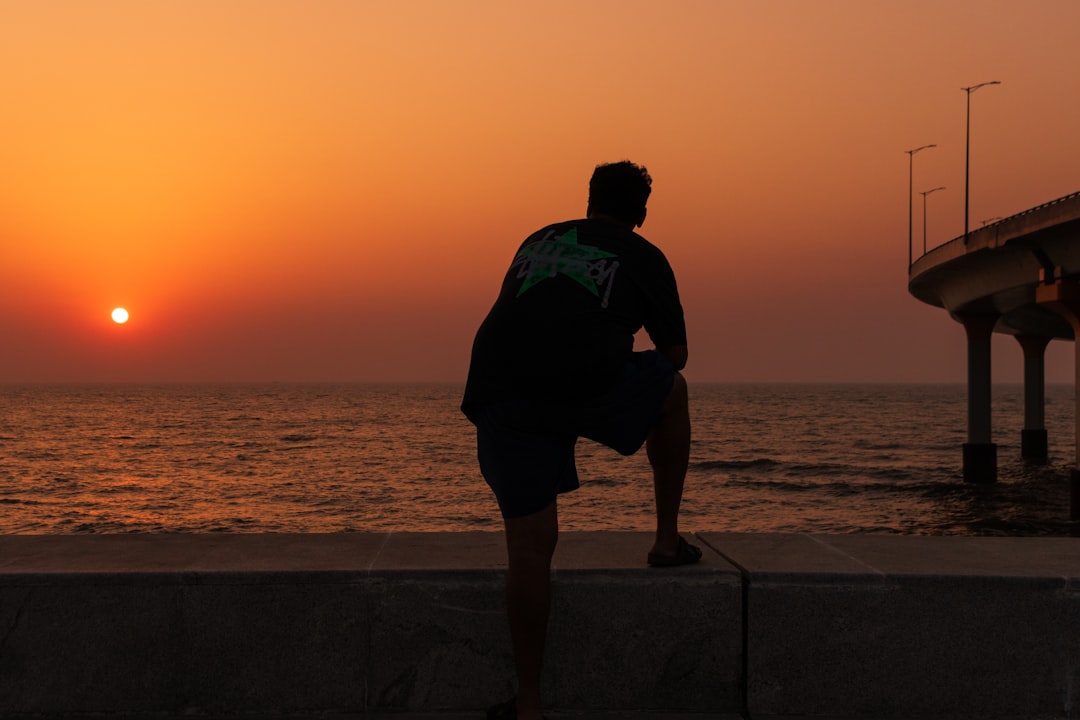
The sun was dropping into the sea, burning the mouth of the Douro into a sheet of polished bronze. The moored fishing boats held their masts up in a row, like a line of silent arms. And there, at the very end of the pier, the boy suddenly stood, lifting both arms high above his head, straight as posts, as if holding something invisible aloft. He held that pose for one minute, two minutes, until the sun had fully sunk beneath the sea. Only then did he lower his arms and let out a soft breath, as though he had finally caught something without dropping it.
The next evening, he came again. And the next. Every sunset, rain or shine.
The tavern sat right at the water’s edge, and Jorge had run it for thirty years. The fishermen soon discovered this strange ritual, and a wagering pool opened up: some said the Easterner was praying, some said it was a newfangled stretch, some said he was dueling the sun—the stakes, a plate of garlic clams. Only Jorge never placed a bet.
“He’s catching something,” Jorge said.
“Catching what?”
“Don’t know.” Jorge wiped a glass. “But he catches it with real care. People who catch things that carefully—what they’re catching matters.”
That Friday, before closing, Jorge carried two glasses of green wine over. The old man walked slowly; thirty years of sea wind had bent his back into a bow.
“What are you catching?” he asked.
The boy thought for a long time. His Portuguese was freshly learned off a phone—words like shells left by a receding tide, you picked up whatever you could.
“Light,” he said, pointing at the sea. “Before the sun falls in, I want to catch it. If I catch it, it’ll have the strength to rise again tomorrow.”
Jorge laughed, the laugh lines brimming with salt. He didn’t mock the notion. Old men who live by the sea all know that some words sound like madness but are, in fact, the oldest honest truth there is.
“Why catch it every day?” he asked.
“Because the light comes every day,” the boy said. “Every time it comes, someone has to catch it.”
The two glasses clinked. Afterward, everyone in the tavern knew: the Eastern boy who came to catch the sun every day was called Ache.
II. Two Years of Darkness
Darkness was not one night.
The winter his father died, Ache thought darkness was a single night. Later he learned that darkness can last two years, or longer—like a geological age, like an ice age, slowly, unarguably covering everything.
His father had been a boiler operator at a power plant in a small northern city, thirty years of it, countless night shifts. He liked to say that half the lights in town, he had watched come on with his own eyes.
When Ache was small, his father once took him up the hill behind their home. At seven in the evening, sharp, the city burst alight as if someone were scattering gold dust from one end of black silk to the other—one square, another square, another. His father flung both arms above his head and cheered, so loudly he scared the sparrows from the trees:
“It’s on—! It’s on—!”
Ache jumped. His father lowered his arms, rubbed his hands, a little embarrassed, and then said, very solemnly: “Darkness can be very long. When the lights come on, somebody has to cheer. Otherwise the electricity shines for nothing, and nothing thanks it.”
Ache was seven that year. He tucked those words away inside himself, together with his father’s raised arms—and kept them there for twenty years.
His father died two winters ago—a heart attack, collapsing in the corridor of the boiler house, never making it to the ambulance. Four seventeen in the afternoon. Later, his mother gave Ache the father’s watch, a mechanical one, wound by hand. No hand moving, no time passing. It had stopped at 4:17, like a small block of frozen time.
And then came Ache’s own two years.
The thesis stopped. The curtains were drawn. The messages went unanswered. Time lost its markings; spring gave way to winter, winter to spring; sunlight crossed the windowsill back and forth like a parcel nobody would sign for. He wasn’t sad—sadness, at least, is warm. He was in a larger, gray calm, like a city with the power out, even the alarms gone mute.
When his mother called from the north, he would pick up and manage three words: “I’m fine.” After hanging up, the room would sink again.
In the seventh month, he went to the hospital. The doctor offered no lecture, only said: “You’re not broken. You’re exhausted. First, sleep yourself back.” Beside the prescription, the doctor added one line: go outside ten minutes a day, find the sun.
Recovery had its own markings. The first month, he could sleep four hours. The third month, he could finish a whole bowl of noodles. The fifth month, he stood at his advisor’s door and said: Professor, I’d like to take a long leave. The advisor looked at him a long time and said: Go. People are bigger than dissertations.
That winter into the following spring, he worked at a bookstore, saving money, studying maps. At last he bought a plane ticket for June.
His mother asked: Why June?
He said: I hear the summers there are long.
III. The Watchmaker of Lisbon
His first stop in Europe was Lisbon. Ache carried two things with him: an old laptop, and his father’s watch, stopped at 4:17.
The alleys of the old city ran downhill, and at one corner there was a watch shop, every watch in the glass case ticking, a hundred times all flowing at once, like a very small, never-ending rain.
The watchmaker was very old, but his hands were steady. Ache laid the watch on the velvet cloth. “It’s broken.”
The old man picked it up, held it to the light for a long while, then opened the case back and squinted, as if reading someone’s private thoughts.
“It isn’t broken,” the old man said. “A mechanical watch with no one to keep it company—it stops, and it waits. It’s been waiting for you two years.”
Tweezers rose and fell, gears meshed, a drop of oil fell where no eye could see. The old man talked as he worked, his voice mingling with the ticking: “A watch that has stopped, once repaired, is no different from any other. Except it knows it has stopped, and so it runs more earnestly.”
Wind the crown. Tick, tock. 4:17 came loose; the hands began to crawl forward—past the dusk, past the night, past two whole years—crawling all the way to a Lisbon afternoon.
“There,” said the old man, handing it back. “Now it keeps Lisbon time. You see—time can move somewhere else.”
When Ache took the watch, his hand trembled once, and then he couldn’t stop. He stood in the middle of all that ticking and wept, helplessly, without any grace. The old man didn’t look at him. He simply reached over and turned the desk lamp up one notch.
“Cry,” the old man said. “There’s no shame in crying over a repair. Tears wind things too.”
He charged very little. Ache tried to give more, and the old man pushed his hand back: “The watch was waiting for a person; the person was waiting for the watch. You found each other. That’s a good thing. You don’t overcharge for good things.”
The sky was still light when he left. Ache heard a small rain falling on his wrist. He raised his arm to his ear and listened for a long time, like someone who had finally gotten a reply, reading the letter through once more.
IV. Half an Orange
On the twenty-first of June, the train headed north, toward Porto. The hillsides outside the window were covered in vines, and the white houses looked like grains of salt scattered on green velvet.
His seatmate was an old woman with a cloth bag on her lap. She was peeling an orange, terribly slowly, the peel coming off in one unbroken spiral that hung down and swayed gently. When she finished, she broke the orange in two and held half out to Ache.
“Eat.”
Ache thanked her. The orange was sour, and after the sourness came a great wave of sweetness.
“Your watch is running,” the old woman said suddenly. Her eyes were no longer young; they spent themselves carefully, looking only at what mattered.
“Yes. Fixed it just two days ago.”
“How long was it stopped?”
“Two years.”
“Then you’re richer than you were yesterday.” The old woman nodded, as if entering a figure in a ledger. She paused, then went on: “My husband’s watch stopped for eleven years. Every Sunday I wound it and let it run ten minutes. Not to tell the time. So that there’d be one watch in the house that still remembered him.”
Ache didn’t know what to say. The old woman didn’t need him to say anything. The train crossed a bridge; below ran a river glinting with shattered light.
Before his stop, the old woman tucked the spiral of orange peel into her cloth bag and said abruptly: “Young man, out in the world—don’t be polite with the dark. When it comes coiling around you, shake it off hard.” She made a brisk shaking motion, a flick of the wrist, far nimbler than her years.
The wind on the platform tasted of the sea. Ache kept the sweetness of that half an orange in his mouth all the way to the door of his hostel.
V. The Night of São João
Porto was celebrating. The whole city was grilling sardines; the smoke was sweet, laced with bonfire and toasted bread, spilling out of every alley. People in the streets carried little plastic hammers and tapped passersby on the head; anyone tapped had to laugh, or they’d get tapped again.
Toward evening, though, Ache shut himself in the tiny room of his hostel.
The darkness had seeped back. It returned knowing all the doors, unreasonable as ever—two years on, and still it came. Ache sat on the edge of the bed and watched the crowds stream toward the sea, the way you’d watch a rain that had nothing to do with you. Music blared from the loudspeakers; people were laughing; those sounds passed through a pane of frosted glass and never reached him.
He remembered what the doctor had said: When it comes back, you don’t have to fight it. You only have to keep it from turning off the lights.
He sat for a long time. Then he heard a sound—tick, tock—rising from his own wrist. A small rain. This watch had been stopped for two years, and in all that time it had never refused repair. If it was willing, so was he.
He went downstairs.
On the beach, bonfires burned in clusters, sparks racing upward until they merged with the first stars. People sang around the fires, and nobody minded a wrong word. An old man threw a handful of herbs into the flames, saying it would burn the past year’s bad luck clean away.
At midnight, fireworks rose from the sea.
When the first one burst, thousands of people across the beach cheered at once, a sound like a rising tide. Ache stood in the shallows, the water pushing at his ankles, wave after wave, the fireworks’ light falling on his face and on thousands of upturned faces.
And suddenly he saw the city at seven o’clock. Black silk, gold dust—one square, another square, another. He saw his father’s arms flung suddenly upward.
He raised his own arms above his head.
“It’s on—!”
The first shout came out hoarse. The second came out bright. He shouted again and again—until the fireworks were spent, until tears and seawater blurred into one thing on his face—until a strange girl beside him tapped him lightly on the head with her plastic hammer and wished him happy festival.
He laughed. He heard his own laughter the way you hear an old friend, long away from home, knocking at the door.
That night, he paid off, in a single installment, two years’ worth of cheering.
From that day on, he had a new ritual: every sunset, he walked to the end of the pier and raised his arms above his head for one minute. He began recording himself—one minute, two minutes: “July third, clear skies, strong wind, a cat came into Jorge’s tavern today. Today’s celebration: complete.”
The recordings grew longer. Sometimes he talked about the watch shop, about half an orange, about a silly notion concerning catching the sun—
No. Not silly, he thought. Old men who live by the sea all know: that is the oldest honest truth there is.
VI. His Mother, on the Other Side of the Continent
Seven hours’ time difference. His mother’s life had quietly bent itself around those seven hours.
She had kept her son’s room exactly as it was. On the balcony grew a sunflower, planted the spring his father died. “I have to plant something,” she told an old colleague. “Otherwise the balcony is too empty, and the words have nowhere to go.”
Her son’s messages were changing. At first, one a month: I’m fine. Then four a month. Then, one day, a one-minute voice message.
She pressed play. First she heard the waves, and then a long-unheard laugh, a little hoarse:
“Mom, the beach was all fire tonight, fireworks rising out of the sea. I shouted ‘It’s on!’ Do you remember how Dad shouted it? I shouted exactly like him.”
On the balcony, his mother listened three times. The sunflower was open, wider than her face.
That evening at seven sharp, she watched the city’s lights come on, square by square. Slowly, she too raised her arms and, imitating him, called softly toward the street lighting up below:
“It’s on.”
Her voice was very soft, as if afraid of waking someone. Then she stood beside the sunflower for a long time. She thought: so cheering can be passed along—across seven time zones, like a relay, baton by baton, whoever finds their strength first raises their arms first.
Her son’s voice messages came more and more often, and longer and longer. She saved each one into a single collection. The name of the collection was her son’s, and it was long: Celebrating Summer in Europe.
Each night before bed she listened to one, like counting a string of prayer beads. On the day she reached the fortieth, her son sent a message: Mom, I bought my ticket home. School starts in September—I’m going back.
She replied with one word: Good.
Then, after a moment, she added: The light has been waiting for you a long time.
VII. Two Masts
At the end of August, the boy came back to the river’s mouth.
All summer, Jorge had watched him come to catch the sun every day, watched him grow a shade darker, watched strength gather in his arms. Today the boy arrived carrying a pack.
“Off, then?” Jorge asked.
“Day after tomorrow. Home first, then back to school. Two years owed—it’s time to pay it back.”
“And after that?”
“Don’t know.” The boy smiled. “Haven’t thought of a name for the next stop yet.”
“Not afraid of not knowing?”
“I used to be.” The boy looked at the sea, which was drawing in its last bolt of gold brocade. “Now I understand. Not knowing just means the place where the light hasn’t come on yet. It always comes on.”
The sun was touching the surface of the sea. The boy stood, and one last time lifted both arms high above his head.
Jorge, steadying himself on the table, slowly rose too.
“You’re catching too?” The boy was a little surprised.
“Practicing,” the old man said. “In case you’re ever late someday, someone has to be here to catch it for you.”
The instant the sun dropped into the sea, old man and young man stood side by side at the end of the pier, four arms raised to the sky. The last of the light stretched their shadows long, long, all the way to the moored boats—like two masts, newly raised.
The sky darkened. And yet Jorge felt that today’s ray of light had not gone out. It had been caught—stored in a young man about to take flight, in a small tavern, beside a sunflower seven time zones away, in every softly spoken “It’s on.”
Darkness can be very long. But when the light comes, you must celebrate it with all your strength.
The day after tomorrow, a plane would fly east. And beyond that, there were still long, long roads to travel, and lights waiting square by square to come on—waiting for someone who had learned to celebrate, to come slowly along, and light them, one by one.
(The End)
This story is adapted from true events; all names are pseudonyms.
Based on a true story