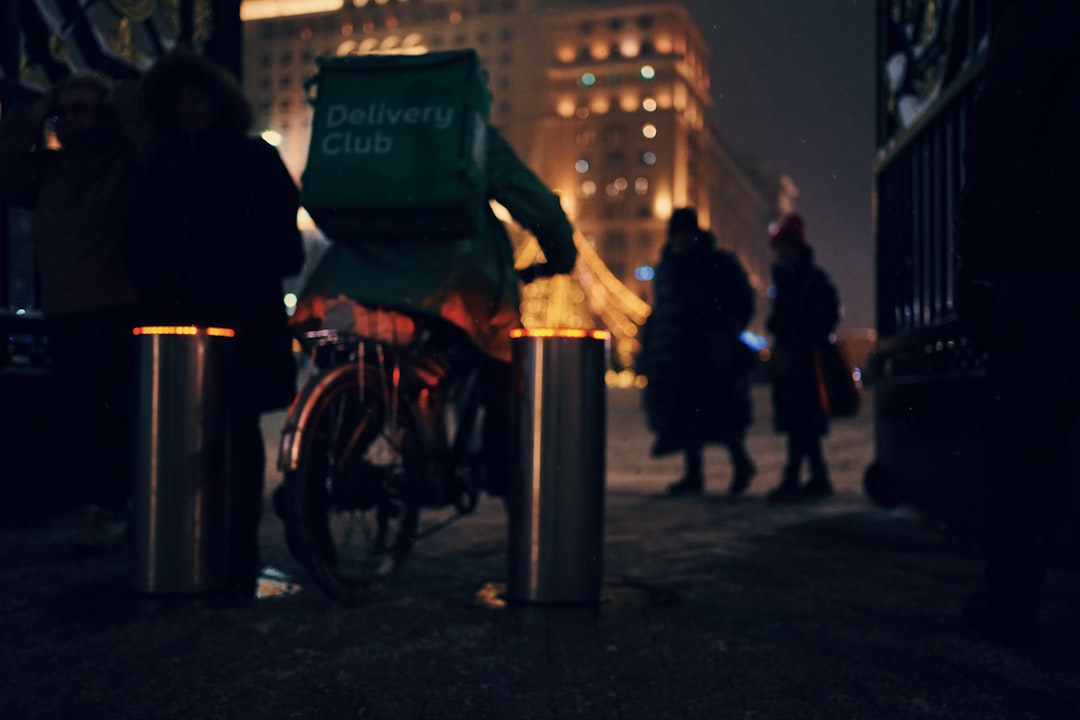
Hold the Line · Chapter Two: The Cola He Paid For Himself
At ten-forty at night, the rain had soaked Chunchao Alley soft.
One corner of the “Fule Burger” lightbox was broken—the character for “burger” reduced to half its strokes, flickering on and off in the rain. No customers inside. Condensation ran down the glass door in bright rivulets. The fryers were off; only the light in the warming cabinet remained, illuminating the last few fries.
Chen Dashan pushed the door open, bringing in a gust of wet cold.
“Dashan? Still running orders at this hour?” Zhou Xiulan looked up from behind the counter. She was the owner’s wife—Kang Youfu’s better half—running the front of house and the register, her voice louder than the signboard.
“Last order of the night.” He handed over his phone. “The note says low blood sugar, begging for priority.”
Zhou Xiulan glanced at it and hollered toward the back: “Youfu! Order number seven—cola!”
From the back room came Kang Youfu’s voice, muffled, laced with the irritation of a man interrupted: “Out of it! Sold out this afternoon!”
“Would Sprite do?” Zhou Xiulan asked.
“The note specifically says cola,” Chen Dashan said. “For low blood sugar, cola works best. The sugar hits fast.”
There was a burst of rummaging in the back, the freezer door opening and shutting. Kang Youfu shuffled out in his slippers, holding a can of cola beaded with condensation—clearly fished up from the very bottom of the freezer.
“Last can. I was saving it for my chess games.” He set the cola down on the counter with a clunk. “Take it. Don’t complain.”
Chen Dashan didn’t grab it right away. He picked it up and swirled it in his palm.
The sound was dull.
Eight years in this trade, and his ears had collected a whole library of sounds. A can full of fizz, when shaken, goes shhh-shhh—water striking metal. A can gone flat goes thunk-thunk—blunt, heavy, like half a can of dead water.
“Youfu, crack it open and let me smell it.”
Pssst—
The tab hissed open, the rush of gas short and soft, like a sigh. Kang Youfu frowned first himself, poured a shallow capful, took a sip—and his face changed. He pushed the cap toward Chen Dashan. “You try it.”
Chen Dashan took a small sip.
Bitter. Not the mellow bitterness of cola—the spoiled kind, syrup gone sour at the back of the tongue, with a trace of rust.
“It’s been sitting too long.” Kang Youfu raked a hand through his hair. “My fault. I just wanted to keep it for myself and forgot to rotate the stock.”
“This can can’t go to a customer.”
“Then what? We’re out of cola—”
“There’s a convenience store at the mouth of the alley.” Chen Dashan clamped his helmet under his arm. “I’ll go buy one. Whatever it costs, I’ll transfer it to you.”
“Transfer, nothing—”
The door curtain had already fallen.
The rain wasn’t heavy, but it was dense. Thirty meters of alley, and Chen Dashan walked it steadily. Somewhere in those thirty meters, he thought of another kitchen.
A few years back, he’d run a noodle shop in the south of the city. Beef noodles, two hundred bowls a day; the broth he’d get up at midnight to simmer—beef bones, chicken carcasses, a handful of spices, and the timing couldn’t be off by a single beat. One rainy day, a girl sat holding her bowl for ten minutes without taking a bite. He went over and asked if something was wrong with the noodles. The girl wouldn’t even raise her head, and said quietly: the broth’s a bit salty—maybe it’s my throat today.
He didn’t argue. He took the bowl away and made a fresh one, with half a spoon less salt and one more spoon of sugar. In his broth, sweetness always came in behind the salt—you couldn’t taste it unless you paid attention. When he set the new bowl down, he said: this one’s on the house. If it still tastes off, you tell me, and I’ll fix it.
The girl became a regular. During her grad-school exam prep she came every day, sitting in the corner, one bowl of noodles with an extra egg. In the slow winter season he memorized every regular’s preferences—who skipped the cilantro, who wanted extra chili, whose noodles needed one minute softer. The year she graduated, she brought him a banner with four characters: The Finest Taste on Earth.
As if there were any “finest taste.” He knew perfectly well: a cook’s tongue has to grow for his customers. The things customers are too embarrassed to say, you have to taste first yourself. When someone entrusts you with a meal, you have to take their discomfort as your own.
The stovetop taught him that. The stovetop doesn’t coddle anyone—fool it once, and it’ll show you bitterness in the pot.
The convenience store light was blindingly white.
On the bottom shelf of the fridge, two-liter bottles of cola stood in a row, beads of water crawling slowly down the plastic. Chen Dashan took the biggest bottle, and asked the girl at the register for pen and paper.
“You write notes too, uncle?” she asked, scanning the bottle.
“Got a message to deliver.”
Seven yuan. He glanced at the amount as he paid. He’d run thirty-one orders today; with the rain surcharge, take-home was just over four hundred. Those seven yuan would take two more kilometers to earn back.
He hesitated for half a second.
Not stinginess. It was the ledger queuing up in his head: Tiantian’s follow-up exam next month, the surgery deposit still short, the rent due on the fifteenth. Every entry in line, no cutting allowed.
Half a second. Just half a second.
He hugged the big bottle to his chest, its cold seeping through his gloves. Holding it this way was like holding an insulated bucket of soup fresh off the stove—an action his arms knew better than his brain.
Hesitation, too, he knew well.
The day his noodle shop closed, he climbed a ladder and took down the wooden sign above the door. Two hand-painted characters, the brushstrokes clumsy but upright: Hold the line. The mover asked: Boss, you want this beat-up board too?
Yes.
The sign was later nailed to the wall of his rented room. Tiantian once asked him: Papa, what does “hold the line” mean?
It’s when the rain comes down hard—you keep your neck stiff. Don’t shrink.
Tiantian, half understanding: Like when they take an EKG and you can’t breathe?
Right. Exactly that kind of strength.
Back at Fule Burger, Kang Youfu was sulking at the flat can of cola, planted on the counter like a mirror of his own face.
“Swapped it.” Chen Dashan set the big bottle on the counter, so cold it was fogging. He tapped his phone. “Seven yuan, sent. Go check.”
“I told you, no need—”
“Don’t be polite with me.” Chen Dashan opened the delivery bag. Fries stacked neat, burger wrapped tight, the box not a bit crooked. He wiped the bottle dry, flipped the convenience-store receipt over, laid it on the counter, and wrote.
Zhou Xiulan leaned in to look. His handwriting wasn’t pretty, but every stroke was a stroke—horizontals level, verticals straight, like soldiers at attention.
“Dear customer: I swapped your cola for a big bottle. The one in the shop had gone flat—not fit to give you. Don’t pay me back; just take care of yourself. Don’t tough out low blood sugar—keep a piece of candy in your pocket. —Your rider, Chen Dashan”
“Well, well,” Zhou Xiulan said. “Signed it, too.”
“A name makes her feel safe—so she knows nobody tampered with anything.” He folded the note into a square and set it under the bottle. “If she wants to leave a bad review later, she’s in the right. I’ll take it.”
Kang Youfu listened to all this without a word, then suddenly turned and went into the back room. When he came out, he was carrying a paper bag, which he stuffed into Chen Dashan’s insulated box without so much as a by-your-leave.
“Fried too many. Two drumsticks, one burger.” He said, “No charge. We’re not restocking tomorrow—they’d just go to waste.”
“Youfu, I can’t—”
“Take it!” Kang Youfu’s voice barked out, then dropped low again as he scuffed the floor with his sole. ”…Tiantian likes drumsticks, doesn’t she?”
Chen Dashan froze.
“You pick her up from school, come past here. Been by twice.” Kang Youfu turned his face away and started wiping a counter that was already clean. “Skinny little thing. Big eyes.”
Chen Dashan’s throat moved, but no polite words came out. He had noticed things: this place’s meat patties were thicker than the others’; the shop was basically empty after ten at night; the lightbox had been broken half a month, and nobody had fixed it. Just now, as Zhou Xiulan tidied the warming cabinet, she’d muttered something about this month’s takings, and Kang Youfu had coughed and changed the subject.
He pressed the paper bag down inside and buckled the box. The e-bike’s taillight swung out of the alley, dragging a streak of red across the wet pavement.
Behind the counter, Kang Youfu did the math in his head: this kid ran thirty-some orders a day, a few yuan each—and he’d shell out seven for a stranger’s bottle of cola.
He looked down at the rejected can and suddenly felt a bit ashamed. In the food business, letting something gone flat lie at the bottom of the freezer for a month—it had nearly walked out the door. Thank goodness for sharp ears.
“Tomorrow I’ll take it back to the supplier,” he said toward the door—half an order, half a talk to himself. “Can’t let the next bottle be bad too.”
Kang Youfu looked again at the line of writing on the back of the receipt. Stubborn characters, stroke by stroke, all of them landing like hammer blows. Suddenly they seemed familiar—like the signboard of some shop on this street, years ago—
He couldn’t remember. Too many shops had gone under on this street to count.
The rain kept falling.
At the main intersection, the light was red. Chen Dashan rested one foot on the ground; his phone buzzed. Not a new order—a message from this order’s customer:
“Sir, the rain’s heavy—no rush. Ride safe. Thank you.”
The light turned green. He tucked the phone back in his pocket and gripped the handlebars a little tighter.
In the insulated box, the drumsticks were still warm. The rented room was eastward; Tiantian should be asleep by now, but she liked a story before bed. Which one to tell tonight, he hadn’t decided yet.
He thought: in this city, tonight, a girl with low blood sugar was about to receive an ice-cold bottle of cola. She didn’t know the story behind those seven yuan, or that the rejected can lay on the counter of Fule Burger, waiting to go settle accounts with the supplier tomorrow.
One bottle of cola, passing from one person’s hand to another’s. Between them: rain, thirty meters of alley, seven yuan, and half a second of hesitation.
And one person who took someone else’s suffering and made it his own.
(This story is adapted from real events. All names are pseudonyms.)
Based on a true story